Table of Contents
- How to Find Reliable Web Design Services Near Me: Where to Start
- How to Vet a Web Design Agency Before You Commit
- Questions to Ask a Web Designer Before Hiring
- Average Cost of Professional Web Design: Budget-to-Outcome Mapping
- What to Look for in a Web Design Contract
- Web Design Project Proposal Template: What a Good One Includes
- Post-Launch Support: The Question Most Businesses Forget to Ask
- How to Find Reliable Web Design Services Near Me: Common Mistakes to Avoid
Last Updated: June 18, 2026
Knowing how to find reliable web design services near me is one of the most practical questions any business owner can ask, and getting the answer wrong costs real money. Ibertech Solutions has helped dozens of businesses across Norfolk and Suffolk avoid exactly this mistake. Below, we break down every stage of the hiring process, from shortlisting candidates to signing a contract, so you can make a confident, informed decision.
How to Find Reliable Web Design Services Near Me: Where to Start
Finding reliable web design services starts with knowing where to look. The quality of your shortlist determines the quality of your final choice.
Using Directories and Platforms to Shortlist Candidates
Several platforms exist specifically to help businesses find vetted design providers. According to Clutch’s B2B agency directory, verified client reviews and detailed agency profiles make it one of the most reliable starting points. For smaller projects, Upwork gives direct access to freelancers with visible work histories, while DesignRush’s agency marketplace offers curated listings by industry and service type. Bark.com sends your brief to nearby professionals and returns responses fast, useful for establishing a rough price range.
A practical shortlisting approach:
- Use Clutch or DesignRush to find three to five agencies with verified reviews
- Use Upwork or Bark to benchmark pricing from freelancers
- Cross-reference any name you find with a direct Google search and a LinkedIn profile check
Local vs. Remote Web Design Services: Which Is Right for You?
Local web design services in Diss and the wider Norfolk region offer face-to-face meetings, shared understanding of the local market, and accountability that comes with proximity. Remote agencies often compete on price but tend to fall short on communication when projects hit complications. For a custom website with ongoing maintenance needs, a local agency is almost always the better choice. For a one-off landing page with a tight budget, a remote freelancer can deliver good results.
How to Vet a Web Design Agency Before You Commit
Vetting a web design agency properly is the single most important step in the hiring process. A polished website and confident sales pitch are not evidence of quality, the evidence is in the portfolio, client references, and technical detail behind the work.
Evaluating Portfolios: What to Look For
Most buyers look at visual design and stop there. What you actually need to assess is whether the agency builds websites that perform, not just websites that look attractive.
When reviewing a portfolio, check for these signals:
- Variety of industries: An agency that has only built sites for one type of business may lack the flexibility your project needs
- Responsive design quality: Open each portfolio site on your phone. If it breaks or feels clunky on mobile, that is a serious red flag
- Load speed: Use Google PageSpeed Insights to test two or three portfolio sites. Slow sites indicate poor technical discipline
- CMS platforms used: Do they work with WordPress, Shopify, or bespoke builds? Make sure their experience matches your requirements
- UI/UX design: Does the user experience feel intuitive? Are conversion elements like calls to action and contact forms well-placed?
Ask the agency to walk you through one project in detail: the brief, the challenges, and what changed along the way. That conversation reveals far more than screenshots.
How to Verify Client Reviews and Testimonials
Client testimonials on an agency’s own website are the least reliable form of social proof. The more credible signals are third-party reviews on platforms like Clutch or Google Business Profile, where the agency cannot edit or remove negative feedback. Look for specific project details, mentions of how problems were handled, reviews from businesses similar to yours, and agency responses to any negative feedback.
Never hire a web design agency based solely on testimonials displayed on their own website. Always check independent platforms for unfiltered feedback. Agencies with no third-party reviews are a significant risk, regardless of how good their portfolio looks.
Technical Vetting Checklist: Going Beyond the Surface
Before committing to any web design agency, run through this checklist:
- Do they provide UK-based hosting, or will your site sit on overseas servers with slower UK load times?
- What CMS will they build on, and will you have full access after launch?
- Do they follow WCAG web accessibility guidelines?
- Will the site be built with SEO optimisation in mind from the start, including clean code, proper heading structure, and metadata?
- Do they handle mobile-friendly, responsive design as standard or as an add-on?
- What security measures do they implement (SSL, regular backups, software updates)?
- Who owns the domain and hosting account after the project completes?
That last point causes more disputes than any other. Make sure ownership is clearly documented before work begins.
Questions to Ask a Web Designer Before Hiring
Knowing the right questions to ask separates buyers who get what they want from those who end up with scope disputes and missed deadlines:
- Can you show me a project similar to mine in scope and industry? Generic portfolios are not enough.
- Who specifically will work on my project? Agencies sometimes sell on senior talent and deliver through junior staff.
- What is your project management process? Look for clear milestones, communication frequency, and revision rounds.
- How do you handle changes to the project scope? This is where costs escalate, understand the process upfront.
- What happens if I am not satisfied with the design direction? A professional agency will have a clear revision policy.
- Do you offer post-launch support and maintenance? Critical, and covered in more detail below.
- Will my site be optimised for SEO from launch? A site that looks good but ranks nowhere delivers no qualified leads.
Ask each agency the same set of questions and compare answers side by side. Agencies that struggle to answer question three or four clearly are likely to struggle with project management in practice.
Average Cost of Professional Web Design: Budget-to-Outcome Mapping
Professional web design pricing varies widely. Here is a practical budget-to-outcome framework based on what different investment levels typically deliver.
| Budget Range | Typical Outcome | Best Suited To |
|---|---|---|
| Under £500 | Template-based site, minimal customisation | Sole traders, early-stage startups |
| £500 – £2,000 | Semi-custom design, basic CMS | Small businesses needing a credible online presence |
| £2,000 – £5,000 | Custom design, responsive, SEO-ready | Growing SMEs needing a conversion-focused site |
| £5,000 – £15,000 | Bespoke development, eCommerce, integrations | Established businesses with complex requirements |
| £15,000+ | Full custom platform, digital marketing integration | Larger organisations with ongoing digital strategy needs |
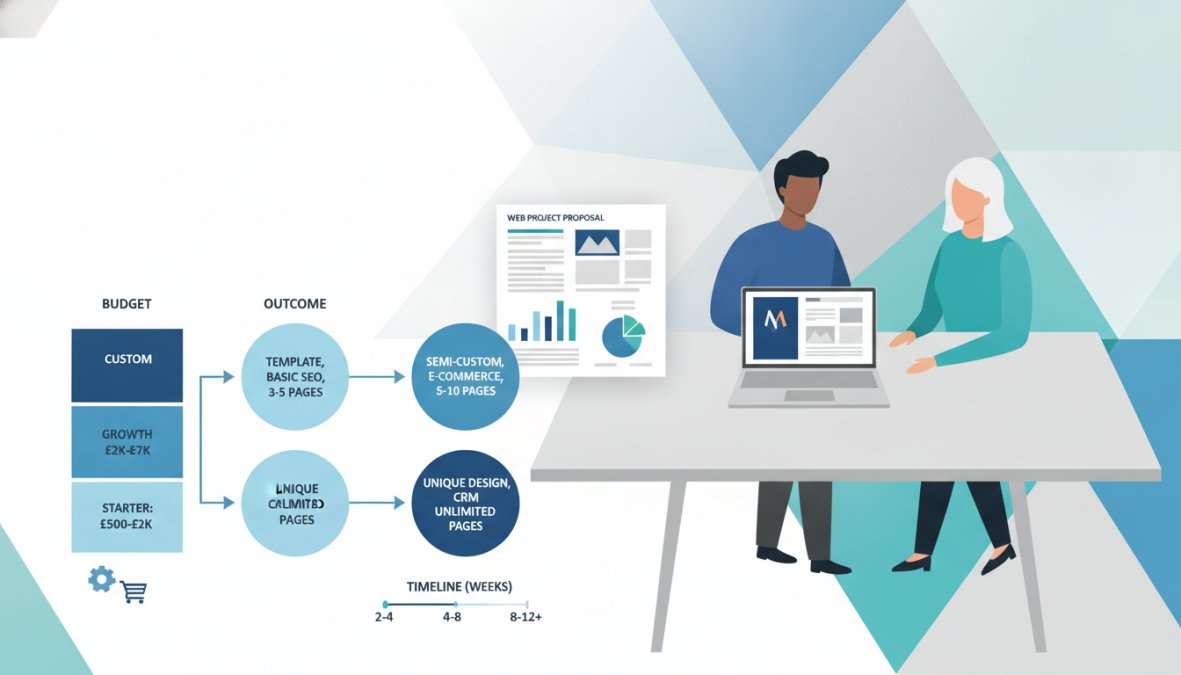
The most common mistake is choosing a budget based on what feels comfortable rather than what the outcome requires. A £700 website will not generate leads in a market where every competitor has invested £5,000 or more.
Freelancer vs. Digital Agency: A Honest Comparison
| Factor | Freelance Web Designer | Digital Agency |
|---|---|---|
| Cost | Lower | Higher |
| Availability | Variable | More structured |
| Range of skills | Limited to one person | Team-based (design, dev, SEO) |
| Project management | Often informal | Defined process |
| Ongoing support | Inconsistent | Usually contractual |
| Brand identity consistency | Depends on individual | Stronger continuity |
Freelancers are excellent for specific, well-defined tasks such as a single landing page or a UI redesign. They are a risk for complex projects requiring web development, SEO, and digital marketing to work together. Agencies carry a higher rate, but structured delivery usually justifies the premium for anything beyond a simple site.
What to Look for in a Web Design Contract
A web design contract is your primary protection against scope creep, missed deadlines, and ownership disputes. A solid contract should include:
- Project scope definition: Exactly what pages, features, and functionality are included
- Payment schedule: Milestone-based payments, not full payment upfront
- Revision rounds: How many are included, and what additional rounds cost
- Ownership clauses: Who owns the design files, domain, and hosting account after completion
- Timeline and milestones: Specific dates, not vague estimates
- Service level agreement: Response times for post-launch support requests
- Intellectual property: Confirmation that you own the final website and all associated assets
According to the UK Government’s guidance on business contracts, written contracts provide essential protection for both parties in service agreements. A verbal agreement or email chain is not a substitute.
The contract clause that catches most businesses out is intellectual property ownership. Always confirm in writing that you own the website, design files, and all content after the final payment clears. Without this, you may find yourself locked in to one provider indefinitely.
Web Design Project Proposal Template: What a Good One Includes
A strong proposal is the first signal of how an agency will manage your project. If the proposal is vague, the project will be too. A good web design project proposal should include:
Project Summary
A clear, two to three sentence description of the project objectives and the business problem being solved.
Scope of Work
A specific list of deliverables: number of pages, functionality, CMS platform, responsive design requirements, and any integrations (eCommerce, CRM, booking systems).
Timeline
A phased breakdown with milestone dates: discovery, wireframes, design approval, development, testing, launch.
Pricing Breakdown
Itemised costs, not a single lump sum. You should be able to see what you are paying for at each stage.
Team
Named individuals who will work on the project and their roles.
Terms
Payment schedule, revision policy, and what happens if either party needs to make changes.
If a proposal does not include all of these elements, ask for them before signing. A well-structured proposal also makes it easier to compare multiple agencies and assess who has genuinely understood your brief.
Post-Launch Support: The Question Most Businesses Forget to Ask
Post-launch maintenance is the most overlooked aspect of the entire web design hiring process. A website requires ongoing attention: software updates, security patches, performance monitoring, content changes, and technical support when things break. Without a clear support arrangement, you are on your own the moment the agency marks the project complete.
Before signing any contract, ask these specific questions:
- Is there a maintenance retainer available, and what does it cover?
- What is the response time for urgent technical issues?
- Are software and plugin updates included, or billed separately?
- Who do you contact if the site goes down at the weekend?
A site that goes down on a Friday afternoon and is not fixed until Monday morning is a tangible business cost. For businesses in Norfolk and Suffolk, Ibertech Solutions provides 24/7 technical support and ongoing website maintenance as part of its service offering, meaning you are never left without support when it matters most.
How to Find Reliable Web Design Services Near Me: Common Mistakes to Avoid
The most common mistakes follow a predictable pattern. Knowing them in advance is the simplest way to avoid them.
Choosing on price alone. The cheapest quote rarely reflects the true cost once revisions, delays, and post-launch issues are factored in.
Skipping the technical vetting checklist. Most buyers never check page speed, accessibility compliance, or hosting arrangements until after problems emerge.
Not clarifying ownership upfront. Confirm in writing that you own the domain, hosting, and all design files. This is the single most common source of disputes.
Ignoring post-launch support. A website needs maintenance, updates, and occasional technical intervention. Agencies that do not offer post-launch support are handing you a car without a service plan.
Relying on portfolio aesthetics alone. A beautiful website that loads slowly, ranks nowhere, and converts no visitors is a failed project. Assess performance, not just appearance.
Not asking who will actually do the work. Ask directly, and get the answer in writing.
According to Google’s Web Fundamentals documentation on site performance, core web performance metrics directly influence search rankings and user experience, meaning technical quality has a measurable impact on your ability to generate qualified leads.
Finding the right web design partner is genuinely difficult when every agency presents itself well online. Ibertech Solutions is a local web design and IT support agency based in Diss, serving businesses across Norfolk and Suffolk, with a team that handles bespoke website development, UK-based hosting, and 24/7 technical support under one roof. If you want a custom website built to generate leads and backed by ongoing maintenance, get in touch with Ibertech Solutions today. CALL US TODAY to discuss your project with a local team that understands your market.
Frequently Asked Questions
How do I know if a web design company is legitimate?
Check for a verifiable physical address, a portfolio of live websites you can visit, and independently verified client reviews on platforms such as Clutch or Google. Look for clear contact details, a professional service level agreement, and transparent pricing. Be cautious of companies that cannot provide references, avoid answering direct questions about their process, or pressure you into signing quickly without a formal project proposal.
What questions should I ask before hiring a web designer?
Key questions to ask a web designer before hiring include: Who will actually build my site, you or a subcontractor? Which CMS platform do you recommend and why? What does the project scope include, and what costs extra? How do you handle responsive design and mobile-friendly performance? What happens after launch, do you offer ongoing website maintenance and technical support? Asking these upfront prevents misunderstandings and helps you compare proposals fairly.
How much should I expect to pay for professional web design services?
The average cost of professional web design varies considerably. A freelance web designer may charge anywhere from a few hundred to a few thousand pounds for a small custom website, while a digital agency typically starts from £2,000 and can reach £20,000 or more for complex builds. Pricing models include fixed-price projects and hourly rates. Your budget should account for not just the build, but also hosting, SEO optimisation, and ongoing maintenance to avoid unexpected costs later.
Is it better to hire a local web designer or a remote agency?
Both options have merit. A local web design service offers face-to-face meetings, a better understanding of your regional market, and easier collaboration, particularly valuable for small and medium local businesses. Remote agencies can offer a broader range of skills and sometimes lower costs. For businesses in areas like Norfolk and Suffolk, working with a local team often means faster response times, on-site support when needed, and a partner who understands the local business landscape.
What are the red flags when hiring a web design service?
Watch out for these warning signs: no verifiable portfolio or only showing template-based work, vague project proposals with no defined deliverables or timeline, reluctance to provide a written contract, no mention of post-launch website maintenance or support, and pricing that seems unusually low with no clear explanation. Also be wary of any provider who cannot explain their approach to responsive design, SEO optimisation, or web accessibility, these are fundamental to a quality build.
How do I verify a web designer's portfolio?
Always visit the live URLs shown in a portfolio rather than relying on screenshots. Check that the sites load quickly, display correctly on mobile, and reflect good user experience principles. Use free tools to test page speed and mobile-friendliness. Cross-reference the work with client testimonials, if a designer claims to have built a site for a named business, search for that business independently to confirm the relationship is genuine before proceeding with your hiring decision.