
Table of Contents
- Is Cyber Essentials Worth the Cost for Small Business: A Cost-Benefit Analysis
- What Is Cyber Essentials and Why Small Businesses Should Care
- Cyber Essentials vs Cyber Essentials Plus: Which Offers Better Value
- DIY vs Managed Service Provider: The True Cost Breakdown
- Cyber Essentials Self-Assessment Checklist and Implementation Effort
- Is Cyber Essentials Required for Government Contracts and Supply Chain Access
- Sector-Specific ROI: Where Certification Delivers Maximum Value
- Post-Certification Maintenance: The Ongoing Cost Reality
Is Cyber Essentials Worth the Cost for Small Business?
Last Updated: July 10, 2026
When small business owners evaluate whether is cyber essentials worth the cost for small business, they’re weighing competing priorities: keeping systems secure, maintaining compliance, and protecting their bottom line. At Ibertech Solutions, we’ve worked with dozens of small firms across Norfolk and Suffolk wrestling with this exact question. The answer depends entirely on your sector, your customer base, and what happens if your systems fail.
This guide cuts through the marketing noise and examines what Cyber Essentials actually delivers, what it costs in time and resources, and whether the investment makes financial sense for your situation.
The Real Investment: Beyond Certification Fees
Most discussions of Cyber Essentials focus only on certification costs. The real expense involves multiple layers: time to implement security controls, ongoing compliance work, and resources needed to maintain certification annually.
The certification process requires you to address five core security controls: secure configuration, user access management, malware protection, patch management, and firewall configuration. Implementing these properly takes 40-80 hours spread across several weeks. For a small team where time is stretched thin, this represents real opportunity cost, an owner spending 60 hours on compliance isn’t spending that time on revenue-generating activities.
The self-assessment checklist often reveals security gaps you didn’t know existed. Use this as a learning opportunity; the controls you implement for Cyber Essentials will protect you long after certification expires.
Annual renewal requires you to reassess your security baseline and confirm controls remain effective. Many businesses underestimate this maintenance burden, it’s an ongoing commitment, not a one-time effort.
Quantifiable Returns for Small Businesses
Where Cyber Essentials delivers measurable value depends heavily on your business model and customer relationships.
If you work in government contracting or supply chain roles, the ROI becomes straightforward: certification is often a requirement for bidding on contracts. Without it, entire categories of work become inaccessible.
For B2B companies selling to larger enterprises, certification signals competence and reduces friction in sales conversations. Procurement teams often ask about security certifications during vendor evaluation. Having Cyber Essentials on your website shortens sales cycles compared to uncertified competitors.
For consumer-facing businesses, the value is less direct but still present. Cyber Essentials demonstrates that you take data protection seriously, building trust in sectors like healthcare, finance, or e-commerce.
The secondary benefit, cyber insurance, varies by provider. Some offer modest premium reductions for certified businesses; others don’t recognise Cyber Essentials at all. Check with your provider before assuming insurance savings will offset costs.
What Is Cyber Essentials and Why Small Businesses Should Care
Cyber Essentials is a government-backed security certification scheme developed by the UK’s National Cyber Security Centre (NCSC) in partnership with IASME. It establishes a baseline of essential security controls that protect against the most common cyber threats.
The certification covers five core areas: secure configuration of hardware and software, user access management, malware protection, patch management, and firewall configuration. These are fundamental security hygiene that every business should implement regardless of certification status.
The scheme exists in two levels. Cyber Essentials is foundational, based on self-assessment. Cyber Essentials Plus adds external audit by an accredited assessor, providing third-party verification that your controls actually work.
For small businesses, the appeal is straightforward: a clear, defined set of security requirements without the complexity of ISO 27001. You know exactly what you need to do and can do it without expensive consultants.
Cyber Essentials addresses the fundamentals, the controls that stop the majority of attacks, but doesn’t protect against advanced persistent threats or targeted attacks. That’s not its purpose. It’s designed to raise the security baseline across the entire business community.
Cyber Essentials vs Cyber Essentials Plus: Which Offers Better Value
The difference between the two levels comes down to verification. Cyber Essentials relies on your self-assessment: you review systems, confirm controls are in place, and submit findings to the certification body. Cyber Essentials Plus involves an external auditor who visits your organisation, tests systems, and verifies controls function as described.
For most small businesses, Cyber Essentials is sufficient. The self-assessment process forces you to document security practices and identify gaps.
Cyber Essentials Plus makes sense if you’re competing for contracts that specifically require external audit verification, or if your sector demands higher assurance. Government tenders sometimes specify Cyber Essentials Plus explicitly. The external audit also catches implementation errors that self-assessment might miss.
| Level | Assessment Type | Cost Implication | Best For |
|---|---|---|---|
| Cyber Essentials | Self-assessment | Lower, initial investment only | Small businesses not pursuing government contracts |
| Cyber Essentials Plus | External audit | Higher, includes auditor fees | Organisations bidding on tenders or in regulated sectors |
The choice depends on whether external verification is a business requirement or a nice-to-have. If required by customers or contracts, Cyber Essentials Plus is essential. If purely defensive, Cyber Essentials delivers core value at lower cost.
Cyber Essentials Plus auditors must be accredited by IASME. Working with an unaccredited assessor wastes money and delivers no valid certification. Verify accreditation before engaging an auditor.
DIY vs Managed Service Provider: The True Cost Breakdown
You can pursue Cyber Essentials through two paths: handle the assessment yourself, or partner with a Managed Service Provider (MSP) or IT consultant.
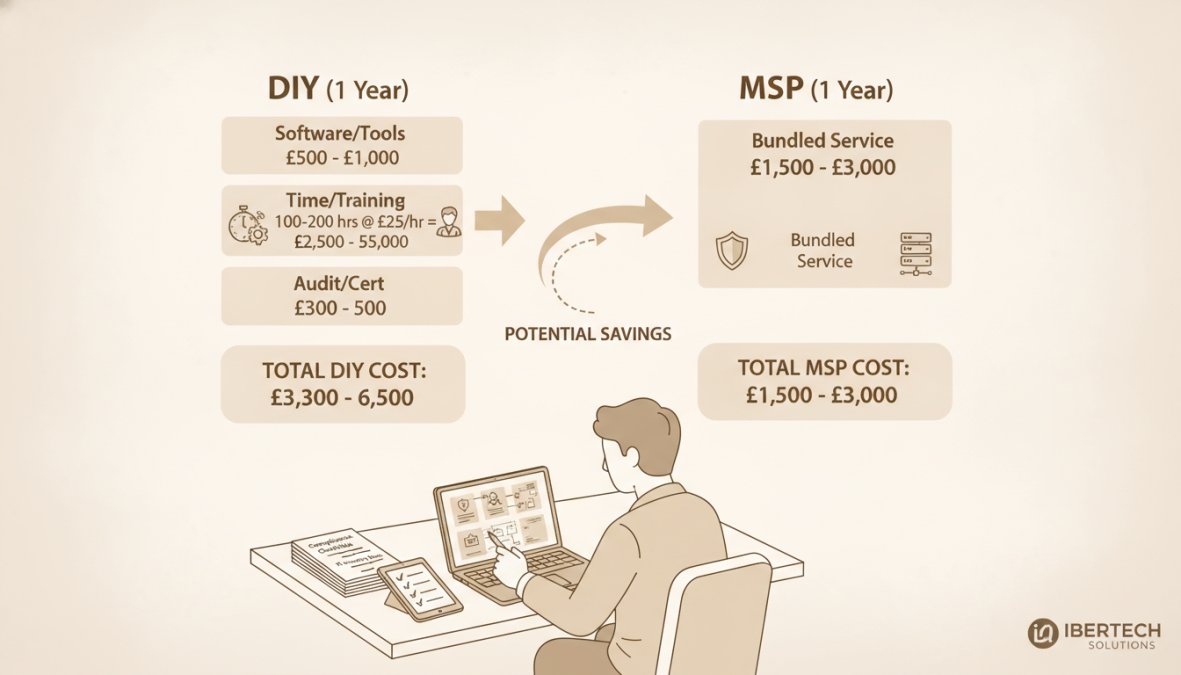
The DIY route saves money upfront but demands time and technical knowledge. You’ll audit systems, document security controls, identify remediation work, and complete the assessment form. For a small business with basic IT infrastructure, this takes 40-80 hours. If you’re doing this yourself, it’s essentially free except for your time.
The MSP route handles the heavy lifting. An MSP will assess your security posture, identify gaps, help implement necessary changes, and guide you through certification. This costs more upfront, typically several hundred pounds, but it’s faster and less disruptive.
For many small businesses, the MSP approach makes financial sense. An MSP can identify efficiency improvements or security gaps that save money elsewhere and help you avoid expensive mistakes. They also free up your time for revenue-generating work.
The ongoing maintenance cost also differs. DIY requires you to stay current on security best practices and manage annual renewals yourself. An MSP typically includes renewal support in their service package.
For most small businesses under 20 employees, partnering with an MSP for Cyber Essentials makes financial sense. The upfront cost is offset by saved time, reduced implementation errors, and included annual renewal support.
Cyber Essentials Self-Assessment Checklist and Implementation Effort
If you pursue self-assessment, understanding what you’re committing to helps you plan realistically.
The self-assessment covers five security domains. For each, you’ll review current practices, document what you’re doing, identify gaps, and implement remediation work.
Secure Configuration requires you to document IT hardware and software, confirm unnecessary services are disabled, and ensure default credentials are changed. For a small business, this means reviewing servers, workstations, and network devices.
User Access Management means implementing role-based access controls, ensuring users have only necessary permissions, and maintaining access records. You’ll audit user accounts, disable inactive accounts, and document your access control policy.
Malware Protection requires deploying and maintaining antivirus software on all devices. You’ll confirm malware definitions are current and scanning is enabled.
Patch Management is often the most time-consuming control. You need to identify all devices and software, track security updates, and apply patches promptly. For businesses running older systems or custom applications, this can be complex.
Firewall Configuration requires documenting your network architecture, confirming firewalls are in place and properly configured, and maintaining firewall rule records.
| Control | Implementation Effort | Ongoing Effort | Common Challenges |
|---|---|---|---|
| Secure Configuration | Medium (20-30 hours) | Low | Legacy systems, custom software |
| User Access Management | Low (10-15 hours) | Medium | Growing team, contractor access |
| Malware Protection | Low (5-10 hours) | Low | Budget constraints, older devices |
| Patch Management | High (20-40 hours) | High | Testing impact, vendor delays |
| Firewall Configuration | Medium (15-25 hours) | Low | Complex network topology |
Total implementation effort ranges from 60-120 hours depending on your current security maturity and system complexity. The realistic timeline is 8-12 weeks from start to certification, assuming part-time work alongside regular responsibilities.
Is Cyber Essentials Required for Government Contracts and Supply Chain Access
This is the primary driver of Cyber Essentials adoption among small businesses. Government procurement now frequently requires certification for suppliers.
The UK government’s Supplier Code of Conduct recommends Cyber Essentials for all suppliers handling government data. More importantly, many government tenders explicitly require certification as a condition of bidding. If you’re competing for public sector work, Cyber Essentials is a requirement.
Beyond government, large enterprises increasingly require Cyber Essentials certification from suppliers. This cascades through supply chains: if you supply to a major retailer or manufacturer, they may require certification before you can bid.
For B2B businesses in regulated industries, finance, healthcare, logistics, Cyber Essentials has become standard in vendor evaluation. It signals that you take security seriously and meet a baseline protection standard.
The competitive advantage is real. A certified business can credibly claim security compliance in sales conversations. An uncertified competitor has to explain why they haven’t pursued it.
If you’re not currently pursuing government contracts or B2B sales to large enterprises, Cyber Essentials is less critical. But if growth plans include those channels, pursuing certification now positions you to compete effectively later.
Government tender requirements often specify Cyber Essentials Plus, not the basic level. If public sector work is part of your strategy, plan for the higher certification level from the start.
Sector-Specific ROI: Where Certification Delivers Maximum Value
The return on investment from Cyber Essentials varies dramatically by industry.
High-value sectors for Cyber Essentials investment:
Technology and software companies benefit significantly. If you’re a SaaS provider, software developer, or IT service firm, Cyber Essentials certification is expected by enterprise customers. Many won’t consider you without it.
Professional services firms, accountants, solicitors, and consultants handle sensitive client data and often operate in regulated sectors. Cyber Essentials demonstrates to clients that you protect their information.
Manufacturing and supply chain businesses increasingly need certification to win contracts from larger customers.
Healthcare providers and social care organisations handle patient data and must comply with data protection regulations. Cyber Essentials aligns with those requirements.
Lower-priority sectors:
Consumer retail businesses with minimal online presence may find Cyber Essentials less critical. If you’re a local shop with a basic website and no major B2B relationships, the certification cost may not justify the benefit.
Sole traders and freelancers working directly for consumers rarely need Cyber Essentials unless pursuing contracts with larger organisations.
The key question is: do my customers or contracts require this certification? If yes, the ROI is clear. If no, evaluate whether the security improvements justify the cost.
Post-Certification Maintenance: The Ongoing Cost Reality
Cyber Essentials certification lasts one year. After that, you must renew to maintain certified status.
Annual renewal requires reassessing your security controls and confirming they’re still in place and effective. This is less intensive than the initial assessment, but it still requires time and attention.
Many businesses underestimate the maintenance burden. They complete initial certification and then neglect ongoing work until renewal arrives, creating a last-minute rush.
Effective post-certification management means treating security as an ongoing responsibility. This means maintaining documentation of your security controls, monitoring patch management, reviewing user access quarterly, testing firewall rules regularly, and staying informed about emerging threats.
For many small businesses, this ongoing work is easier with an MSP managing it. They’ll handle the renewal assessment, track compliance, and alert you to needed changes.
The cost of neglecting post-certification maintenance is high. If certification lapses, you lose the competitive advantage. If security controls degrade and a breach occurs, you face liability and reputational damage.
Certification lapses if you miss the annual renewal deadline. Plan your renewal process at least three months before your certification expires to avoid gaps in certified status.
Whether is cyber essentials worth the cost for small business ultimately depends on your competitive landscape and customer requirements. If government contracts, B2B sales, or regulated industries are part of your growth strategy, certification delivers clear ROI. If you’re purely consumer-focused, the value is less obvious, though the security improvements themselves remain valuable.
At Ibertech Solutions, we help small businesses in Norfolk and Suffolk implement Cyber Essentials efficiently, often identifying cost savings and security improvements that offset the certification investment. Our 24/7 IT support team can guide you through the assessment, help with remediation, and manage ongoing compliance. Whether you pursue certification or not, the security controls it requires will strengthen your defences against the threats facing your business today.
Frequently Asked Questions
How much does Cyber Essentials certification cost for a small business?
Certification costs vary depending on whether you choose self-assessment or external audit, and whether you use an MSP or handle implementation internally. Self-assessment is typically the lower-cost route, whilst external audits for Cyber Essentials Plus cost more. Additional expenses include remediation work to meet security controls and annual renewal fees. For accurate pricing tailored to your situation, contact a local IT support provider who can assess your current infrastructure and provide a detailed quote.
Is Cyber Essentials required for small businesses?
Cyber Essentials is not mandatory for most small businesses operating independently. However, it becomes essential if you bid for government contracts, work in regulated sectors like finance or healthcare, or supply to larger organisations that require it as part of their supply chain security requirements. Many B2B clients now request certification as a baseline security standard, making it increasingly valuable for competitive positioning.
What are the main benefits of Cyber Essentials for SMEs?
Key benefits include demonstrating security commitment to clients and partners, meeting government tender requirements, reducing cyber insurance premiums in some cases, and establishing a security baseline that protects against common threats. Certification also provides a structured framework for implementing essential security controls like firewall configuration, patch management, and access control, reducing your exposure to malware and phishing attacks.
How long does it take to get Cyber Essentials certified?
Timeline depends on your current security posture and chosen route. Self-assessment can take 4-8 weeks if your infrastructure is already reasonably secure, but remediation work may extend this. External audits for Cyber Essentials Plus typically add 2-4 weeks. Using an MSP can accelerate the process by handling assessment and remediation in parallel, though the overall timeline still depends on how much work your systems require.
Does Cyber Essentials protect against all cyber attacks?
No. Cyber Essentials covers essential security controls, firewall configuration, secure configuration, malware protection, patch management, and access control, but it's a baseline, not comprehensive protection. It defends against common threats like phishing and malware but doesn't address advanced persistent threats or sophisticated targeted attacks. Think of it as foundational risk mitigation rather than complete security coverage. Many businesses combine it with cyber insurance and ongoing threat monitoring.