
Table of Contents
- How to Create an Incident Response Plan: Key Foundations
- Understanding the NIST Incident Response Framework
- Step 1: Preparation and Planning
- Step 2: Detection and Analysis
- Step 3: Containment Strategies
- Step 4: Eradication and Recovery
- Incident Response Team Roles and Responsibilities
- Using an Incident Response Plan Template
How to Create an Incident Response Plan: A Step-by-Step Guide
Last Updated: July 16, 2026
How to Create an Incident Response Plan: Key Foundations
A documented incident response plan transforms chaos into coordinated action when security threats emerge. Without one, organisations lose precious time to confusion and poor communication. When an incident strikes, every hour counts. A plan ensures your team knows exactly what to do, who does it, and how to communicate throughout the process.
An incident response plan is your organisation’s playbook for detecting, containing, and recovering from security incidents. Without one, response times stretch, costs multiply, and damage spreads.
Why Your Organisation Needs a Documented Plan
The question isn’t whether your organisation will face a security incident, it’s when. A documented plan eliminates decision paralysis by establishing clear procedures and defined roles. It ensures consistent response across incidents and demonstrates due diligence to regulators and stakeholders. Without a plan, incident response becomes reactive and fragmented, with different team members taking conflicting actions, critical steps skipped, and recovery taking longer and costing more.
What You’ll Need Before Starting
Before drafting your incident response plan, gather these foundational elements:
- Executive sponsorship: Leadership must endorse the plan and commit resources
- Stakeholder input: Gather perspectives from IT, security, legal, communications, and business leaders
- Asset inventory: Document critical systems and data repositories
- Regulatory requirements: Identify compliance obligations specific to your industry
- Contact information: Compile internal and external contacts
- Budget allocation: Set aside resources for tools, training, and exercises
Understanding the NIST Incident Response Framework
The NIST SP 800-61 framework provides a structured approach to incident response that has become the industry standard. It organises incident response into four distinct phases, each with specific objectives.
The Four Phases: Preparation, Detection, Containment, and Recovery
Preparation establishes policies, acquires tools, trains staff, and documents procedures. This phase is ongoing as threats evolve.
Detection and Analysis begins when a potential incident is identified. Your team investigates whether an actual security event has occurred, classifies its severity, and initiates response procedures. Speed matters; early detection limits damage.
Containment stops the incident from spreading. This might mean isolating affected systems, revoking compromised credentials, or blocking malicious traffic. Containment has three levels: short-term (stop immediate damage), long-term (prevent recurrence while maintaining operations), and recovery (restore systems to normal).
Eradication and Recovery removes the threat and restores systems to normal operation. This includes identifying and fixing vulnerabilities, rebuilding compromised systems, and verifying the threat is fully eliminated.
Step 1: Preparation and Planning
Preparation establishes the foundation for faster, more effective response when incidents occur.
Define your incident response policy at the organisational level, stating management’s commitment, defining roles and responsibilities, and outlining the activation process. Develop Standard Operating Procedures (SOP) for common incident types. Rather than one massive plan, create focused playbooks for ransomware, data breaches, denial-of-service attacks, and insider threats. Each playbook should specify detection indicators, initial response steps, containment actions, and recovery procedures.
Establish security controls that support incident response, including centralised logging and monitoring systems that generate forensic data. Implement network segmentation so compromised systems can be isolated without disrupting entire operations. If your organisation requires assistance with IT infrastructure and security controls, IT Support can help establish the foundational systems needed for effective incident detection and response.
Create a “playbook library” rather than one monolithic plan. Separate playbooks for different incident types are easier to maintain, test, and execute under pressure.
Defining Incident Classification and Severity Levels
Develop a classification scheme that categorises incidents by type: malware infection, unauthorised access, data exfiltration, denial of service, insider threat, or third-party compromise. Establish severity levels (low, medium, high, critical) based on business impact. Severity determines response urgency and escalation; critical incidents trigger immediate executive escalation and may require external notification.
Establishing Security Policies and Standard Operating Procedures
An effective incident response policy should address who is authorised to declare an incident, when the plan is activated, how communication flows, evidence preservation requirements, notification obligations, and organisational support for affected individuals.
SOPs should be specific enough that someone unfamiliar with your environment could follow them. Document them in an accessible format, a wiki, dedicated platform, or printed copies, rather than a 500-page PDF buried on a shared drive.
Step 2: Detection and Analysis
Detection relies on multiple signals: security tools like intrusion detection systems and SIEM platforms, user reports, and threat intelligence. The challenge is distinguishing real incidents from false positives. Your detection procedures should define how alerts are triaged, who investigates them, and what evidence confirms an actual incident.
Once an incident is confirmed, your team moves into analysis mode, collecting evidence, preserving it properly, and documenting findings in a chain of custody log.
Implementing Threat Intelligence and Vulnerability Assessment
Subscribe to threat intelligence feeds relevant to your industry and geography. These provide information about active campaigns, newly discovered vulnerabilities, and indicators of compromise associated with known threat actors. Regular vulnerability scans reveal missing patches, misconfigured services, and weak credentials. Prioritise remediation based on severity and exploitability.
Combine threat intelligence and vulnerability assessment into a risk picture to guide preparation activities and anticipate likely incidents.
Step 3: Containment Strategies
Containment stops an active incident from spreading. For ransomware, immediate isolation prevents encryption from spreading. For data breaches, containment might mean revoking compromised credentials. For malware, it could involve blocking malicious domains or removing malware from endpoints.
Short-term containment prioritises stopping immediate damage, even if it disrupts operations. Long-term containment maintains security while restoring functionality. Containment requires coordination across security, IT, and communications teams.
Evidence Preservation and Chain of Custody
Chain of custody is the documented record of who handled evidence, when, and what they did with it. A broken chain can render evidence inadmissible in legal proceedings.
When preserving evidence, minimise changes to compromised systems, document everything, use write-blocking devices when acquiring data, maintain secure storage, and generate cryptographic hashes to prove files haven’t been altered. If your organisation lacks forensic expertise, consider engaging a professional investigation firm.
Step 4: Eradication and Recovery
Eradication removes the threat entirely through patching vulnerabilities, removing malware, revoking compromised credentials, or rebuilding systems. Recovery restores systems to normal operation through rebuilding from clean backups and restoring data.
Verification is crucial. After eradication and recovery, confirm that vulnerabilities have been fixed, malware has been completely removed, compromised credentials have been changed, systems are functioning normally, and no signs of compromise remain in logs.
Business Continuity and Disaster Recovery Planning
Business continuity planning identifies critical functions and ensures they can continue during disruptions. Disaster recovery planning focuses on IT systems and defines recovery time objectives (RTO) and recovery point objectives (RPO).
Meeting these objectives requires current backups stored offline and tested regularly, documented recovery procedures for critical systems, and identified alternative suppliers or facilities. Test your disaster recovery plan at least annually through tabletop exercises and simulations.
Untested disaster recovery plans often fail when you need them most. Test recovery procedures at least annually and update based on what you learn.
Incident Response Team Roles and Responsibilities
Incident response requires coordination across multiple disciplines. Your team structure depends on organisation size and complexity.
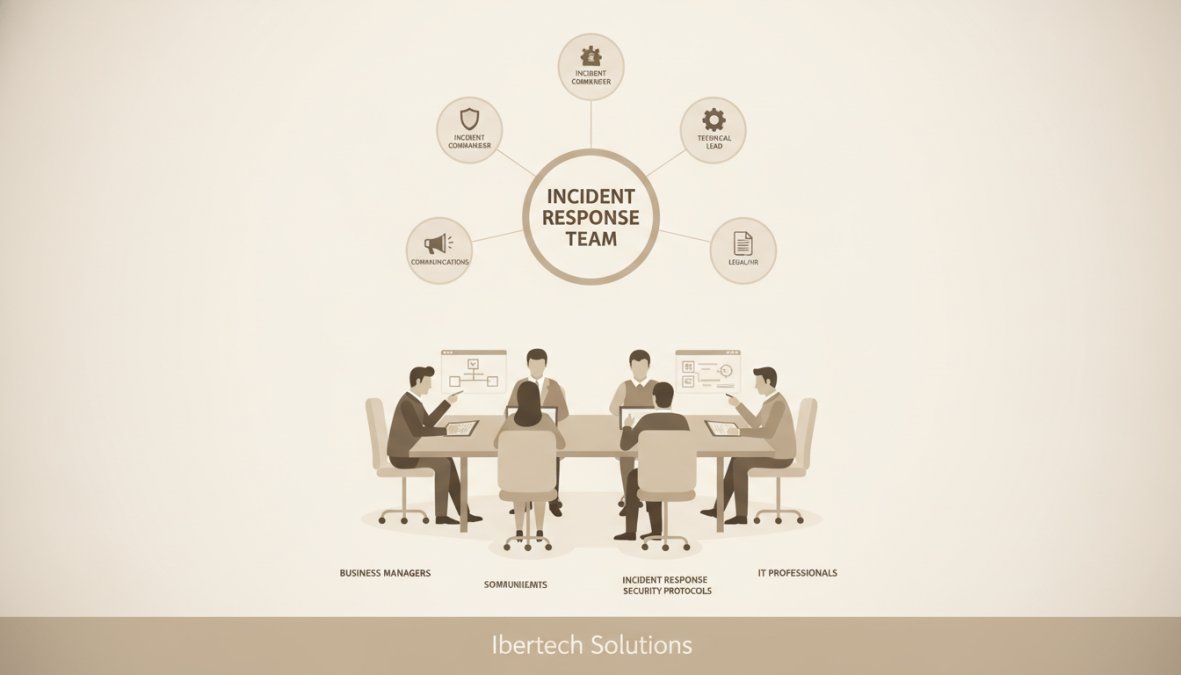
Building Your Incident Response Team (IRT)
Incident Commander oversees the response, ensures procedures are followed, and coordinates communication.
Security Analyst investigates the incident, collects evidence, and determines what happened.
Systems Administrator executes containment and recovery actions.
Communications Lead manages internal and external communication.
Legal Advisor ensures response activities comply with applicable laws.
Business Representative represents the affected business unit and helps prioritise recovery.
For smaller organisations, one person might fill multiple roles. The key is ensuring all necessary expertise is available and coordinated.
Stakeholder Management and Communication Protocols
Develop a communication plan defining who needs notification at each stage, what information each stakeholder needs, how they’ll be notified, and update frequency. Internal communication should be frequent and transparent. External communication should be coordinated carefully through designated spokespersons following legal guidance.
Establish a secure communication channel for the incident response team and document all communication, recording who was notified, when, what was communicated, and their response.
Using an Incident Response Plan Template
A template provides structure and ensures your plan addresses all necessary elements. A good template is comprehensive but flexible, detailed enough to be useful but concise enough to be usable under pressure.
Key Sections Your Template Must Include
Policy and Authority defines the incident response policy and establishes team authority.
Incident Classification and Severity Levels ensures consistent response.
Roles and Responsibilities documents team structure and identifies individuals filling each role.
Detection and Reporting Procedures explains how incidents are detected and reported.
Incident Response Procedures provides step-by-step procedures for each phase.
Communication Plan defines notification procedures and contact information.
Evidence Preservation and Chain of Custody documents collection and storage procedures.
Business Continuity and Disaster Recovery references continuity plans and integration with incident response.
Post-Incident Activities defines the review process and plan updates.
Appendices include playbooks for specific incident types, contact lists, and templates.
| Section | Purpose | Key Content |
|---|---|---|
| Policy & Authority | Establish incident response framework | Policies, escalation procedures, authority limits |
| Classification & Severity | Ensure consistent incident assessment | Incident types, severity criteria, response levels |
| Roles & Responsibilities | Define team structure | Positions, responsibilities, contact information |
| Detection Procedures | Enable incident identification | Detection sources, triage process, confirmation criteria |
| Response Procedures | Guide containment and recovery | Step-by-step procedures for each incident phase |
| Communication Plan | Manage stakeholder notification | Notification procedures, templates, contact lists |
| Evidence Preservation | Protect investigative integrity | Collection procedures, chain of custody, storage |
| Business Continuity | Maintain operations during incidents | RTO/RPO targets, alternative resources, testing schedule |
| Post-Incident Review | Enable continuous improvement | Review process, lessons learned, plan updates |
Review your plan annually and update it based on lessons learned from incidents and significant environmental changes.
Store your incident response plan in multiple formats and locations. Keep a current version on your internal wiki. Maintain a PDF copy in a shared drive. Print a copy and store it securely. If primary systems are compromised, you need access to your plan.
Testing Your Incident Response Plan
A plan that hasn’t been tested is largely theoretical. Testing reveals gaps, identifies unclear procedures, and builds team familiarity before a real incident occurs.
Tabletop exercises are the most practical approach. Your incident response team gathers to walk through a simulated incident scenario. A facilitator presents the scenario and injects complications as the exercise progresses. Conduct at least one tabletop exercise annually.
For more comprehensive testing, conduct a full-scale exercise where your team executes response procedures in a test environment. After any exercise or real incident, conduct a post-incident review, documenting what went well and what needs improvement.
Regulatory Compliance and Incident Response
Depending on your industry and data handled, incident response may be a regulatory requirement. If your organisation operates in the UK and handles personal data, the UK GDPR requires processes for responding to personal data breaches. You must notify affected individuals and the Information Commissioner’s Office within 72 hours of discovering a breach that poses a risk to individuals’ rights.
When developing your incident response plan, research specific regulatory requirements applicable to your organisation and ensure your plan addresses these requirements explicitly.
Automating Incident Response
As your organisation matures, automation can improve incident response speed and consistency. Security orchestration, automation, and response (SOAR) platforms can automatically isolate compromised endpoints, revoke suspicious credentials, or block malicious IP addresses when certain conditions are detected.
Automation works best for well-defined, repeatable response actions. Start with automation for your highest-volume, most predictable incident types. Maintain human oversight of automated actions.
Budgeting for Incident Response
Effective incident response requires investment in tools, training, and personnel. Tools include SIEM systems, EDR platforms, and incident response platforms. Training is essential for your incident response team. Personnel costs are often the largest expense. The cost of incident response is substantial, but the cost of inadequate response is far higher.
Post-Incident Activities and Continuous Improvement
When an incident is resolved, conduct a post-incident review within a week. Gather your incident response team, affected business units, and relevant stakeholders. Walk through the incident timeline and identify what went well and what could be improved.
Document lessons learned and use them to update your incident response plan, refine procedures, and prioritise improvements. This continuous improvement cycle ensures your incident response capabilities evolve as threats change.
Effective incident response results from careful planning, regular practice, and continuous improvement. A documented incident response plan transforms your organisation’s response to security incidents from reactive improvisation to coordinated, professional action. Start with preparation, define clear procedures, establish your team structure, and test your plan regularly. As your organisation matures, refine procedures based on lessons learned and evolving threats.
Frequently Asked Questions
What should be included in an incident response plan?
A comprehensive incident response plan should include incident classification and severity levels, roles and responsibilities for your Incident Response Team, communication protocols for internal and external stakeholders, detection and analysis procedures, containment strategies, eradication and recovery steps, evidence preservation and chain of custody guidelines, business continuity measures, and post-incident review processes. Many organisations use an incident response plan template as a starting point to ensure nothing is overlooked.
How often should you review and update your incident response plan?
Your incident response plan should be reviewed and updated at least annually, or whenever significant changes occur to your IT infrastructure, security controls, or business operations. Additionally, after each security incident or tabletop exercise scenario, conduct a lessons learned session to identify improvements. Regular testing through playbooks and tabletop exercises helps identify gaps that may require updates to your plan.
What is the difference between an incident response plan and a playbook?
An incident response plan is a comprehensive framework covering your entire incident management process, including preparation, detection, containment, eradication, and recovery phases based on standards like NIST SP 800-61. Playbooks are detailed, step-by-step instructions for responding to specific types of incidents. Your plan provides the overall structure and governance, whilst playbooks provide the tactical procedures for handling particular threat scenarios.
How can automation improve your incident response?
Automation in incident response accelerates detection, containment, and recovery by reducing manual intervention time. Security orchestration tools can automatically isolate affected systems, gather forensic evidence, notify stakeholders through communication protocols, and execute predefined response actions. Automation also ensures consistent application of your Standard Operating Procedures and reduces human error during high-pressure incidents, allowing your Incident Response Team to focus on complex decision-making.