Table of Contents
- Managed IT Services vs Break-Fix: Understanding the Two Models
- Proactive vs Reactive IT Maintenance: Why the Difference Matters
- Managed Services vs Break-Fix Cost Comparison
- Key Benefits of Managed IT Services for Growing Businesses
- Downtime, Security, and the Hidden Costs of Break-Fix
- Hybrid IT Support Models: The Best of Both Worlds?
- Managed IT Services vs Break-Fix: Which Model Is Right for Your Business?
- Conclusion
Last Updated: June 2026
Managed IT Services vs Break-Fix: Understanding the Two Models
Choosing between managed it services vs break-fix is one of the most consequential IT decisions a small or medium-sized business will make, yet most guides reduce it to a simple cost comparison. At Ibertech Solutions, we work with businesses across Norfolk and Suffolk every day, and the reality is far more nuanced. The model you choose shapes your security posture, your ability to scale, and how much unplanned downtime you absorb. Below, we’ll show you exactly how to think through that decision, including a practical ROI framework and a look at hybrid models that most guides ignore entirely.
What Is Break-Fix IT Support?
Break-fix IT support is a reactive support model where a business calls a technician only after something has already failed. There is no ongoing contract, no proactive monitoring, and no SLA governing response times. You pay for the time and materials required to fix the specific problem, then the engagement ends. Simple, transactional, and, as we’ll cover, increasingly costly for growing businesses.
What Are Managed IT Services?
Managed IT services is a proactive model where a managed service provider (MSP) takes ongoing responsibility for your IT infrastructure under a flat-rate subscription. The MSP uses remote monitoring and management (RMM) tools to watch your systems continuously, applying patches, flagging anomalies, and resolving issues before they become failures.
A full managed services contract typically covers:
- 24/7 remote monitoring and management of servers, endpoints, and networks
- Scheduled maintenance, patching, and software updates
- Help desk access for staff during business hours (or around the clock)
- Cybersecurity tools including endpoint protection and threat detection
- Vendor management and IT strategy consulting
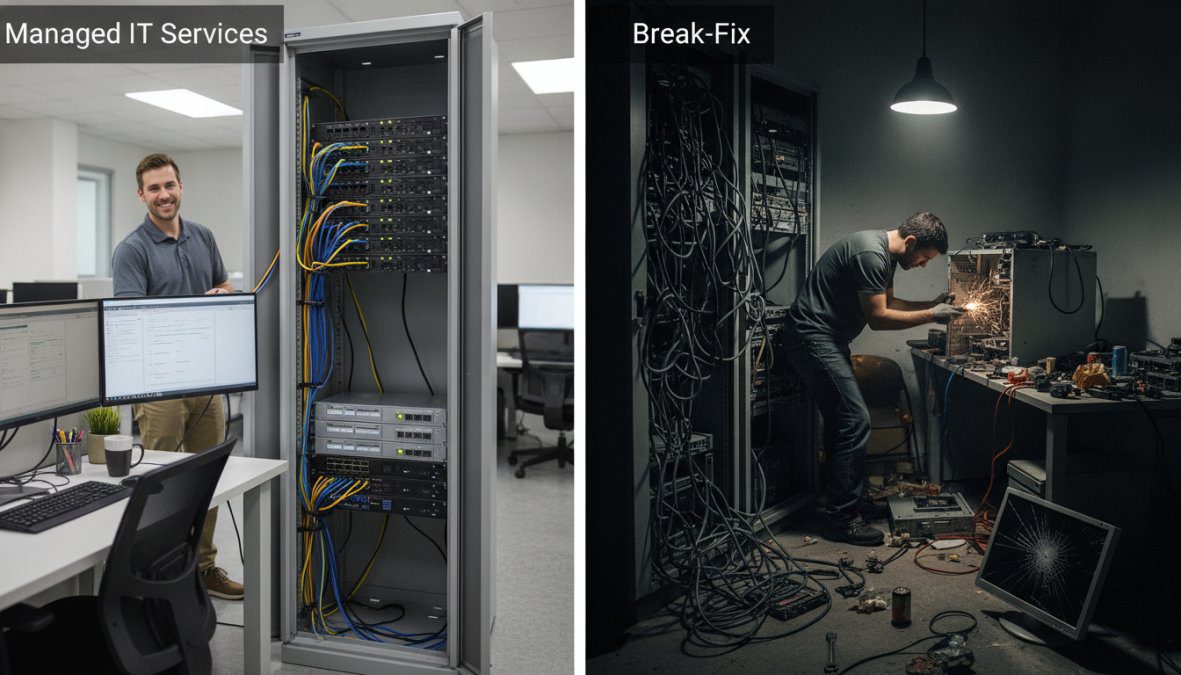
The fundamental shift is from incident response to preventive care.
Proactive vs Reactive IT Maintenance: Why the Difference Matters
Most businesses underestimate the gap between these two approaches until they experience a serious failure.
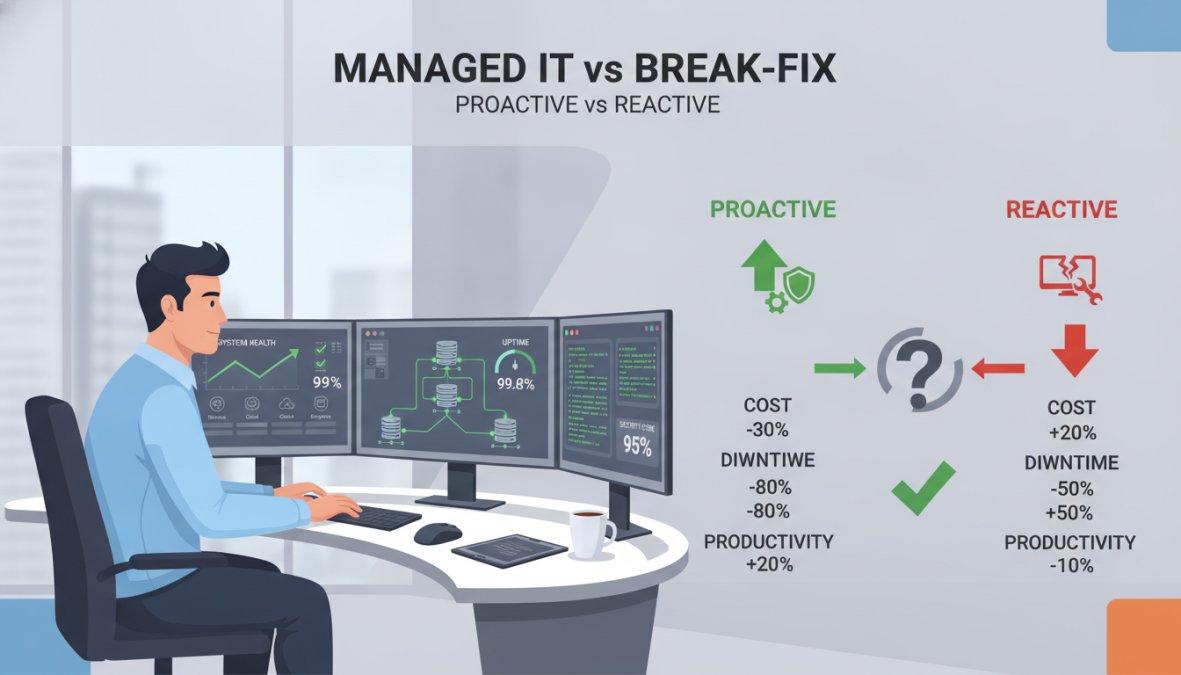
Reactive support means your systems have already failed before anyone acts. Downtime has started, staff cannot work, and revenue is pausing while the technician is still en route. Every hour of IT failure carries a real productivity cost, and for customer-facing businesses, a reputational one too.
Proactive monitoring flips that sequence. An RMM platform can detect a failing hard drive before it dies, flag a suspicious login before it becomes a breach, and push a critical patch before a vulnerability is exploited, often automatically, before your team sits down at their desks.
A common mistake is assuming systems are "stable enough" to justify break-fix, only to discover that stability was masking gradual technical debt: ageing hardware, unpatched software, and a security posture that hasn’t kept pace with modern threats.
Businesses running on break-fix support often discover during a major incident that their backup systems haven’t been tested in months. Without scheduled maintenance and oversight, backup failures go unnoticed until the moment they matter most.
For businesses in Diss and the wider Norfolk region, the difference between a four-hour wait for a break-fix technician and an MSP resolving an issue remotely within minutes can be the difference between a minor inconvenience and a lost trading day.
Managed Services vs Break-Fix Cost Comparison
Here’s where it gets interesting, because the obvious cost comparison misses the point entirely.
Break-Fix: Hourly Rates and Time-and-Materials Billing
Break-fix support operates on a time-and-materials basis. You pay for each incident: the technician’s hourly rate, parts, and travel. There is no monthly commitment, which makes it appear financially attractive, until a single server failure requiring emergency out-of-hours support, replacement hardware, and several hours of recovery generates a bill that dwarfs months of managed services fees. IT budget predictability is essentially zero under this model.
Managed Services: Flat-Rate Pricing and IT Budget Predictability
Managed services contracts use flat-rate pricing, typically charged per user or per device per month, giving businesses complete cost predictability. The MSP is incentivised to keep your systems running cleanly because every incident they prevent saves them time and cost, their business model aligns with your operational interests in a way that break-fix simply does not.
Simple ROI Framework: Estimating the Real Cost of Each Model
Use this framework to compare the two models for your own business:
Break-Fix Annual Cost Estimate:
- Average incidents per year x average cost per incident
- Add: estimated hours of downtime x cost per hour of downtime (staff wages + lost revenue)
- Add: any emergency or out-of-hours call-out premiums
Managed Services Annual Cost Estimate:
- Monthly fee x 12
- Add: any out-of-scope project costs
The comparison that matters: If your estimated break-fix cost (including downtime) exceeds your managed services annual cost, the managed model delivers ROI before you factor in any security or productivity benefits.
| Factor | Break-Fix | Managed IT Services |
|---|---|---|
| Billing model | Time-and-materials | Flat-rate monthly |
| Cost predictability | Low | High |
| Proactive monitoring | None | Continuous (RMM) |
| Response trigger | After failure | Before failure |
| Security coverage | Incident-only | Ongoing posture management |
| SLA guarantees | Rare | Standard |
| IT strategy support | None | Often included |
| Best for | Simple, stable environments | Growing or complex businesses |
According to Gartner’s IT spending guidance, unplanned downtime consistently ranks as one of the top drivers of unbudgeted IT expenditure for small and mid-sized businesses.
Key Benefits of Managed IT Services for Growing Businesses
The businesses that benefit most from managed IT services are often those in the 10-100 employee range, precisely because they lack the internal IT headcount to manage infrastructure proactively on their own.
The core benefits are practical and measurable:
Operational efficiency. Staff spend less time dealing with IT problems. A help desk available during business hours means issues get resolved quickly rather than festering.
Scalability. As your business grows, IT support scales with it under the same contract, no renegotiation required.
Reduced technical debt. Regular patching, hardware lifecycle management, and system oversight prevent the slow accumulation of outdated, vulnerable infrastructure.
Vendor management. A good MSP manages relationships with software vendors, ISPs, and hardware suppliers on your behalf, saving management time.
Business continuity. Managed services contracts typically include backup monitoring and disaster recovery planning, ensuring fast recovery and minimal data loss when something goes wrong.
As documented in CompTIA’s annual IT industry analysis, businesses that move from reactive to proactive IT management consistently report improvements in staff productivity and reductions in unplanned downtime.
The financial case for managed IT services isn’t just about avoiding large repair bills. It’s about the cumulative cost of small inefficiencies: slow systems, unresolved minor issues, and staff time lost to IT problems that proactive monitoring would have prevented.
Downtime, Security, and the Hidden Costs of Break-Fix
The real cost of break-fix support is never the invoice. It’s everything that happens between the failure and the fix. If five members of staff cannot work for three hours while waiting for a technician, that’s fifteen hours of lost productivity before a single invoice arrives. For businesses with customer-facing systems, website downtime or payment processing failures carry additional revenue implications.
Cybersecurity Posture: A Security-First Comparison
Break-fix support has no mechanism for maintaining your cybersecurity posture between incidents. Patches get applied reactively, if at all. Endpoint protection may be outdated. Threat monitoring is nonexistent. Modern cyber threats do not wait for you to call a technician.
Managed IT services include continuous security oversight as a core component. RMM platforms flag suspicious activity in real time, patch management runs on a schedule, and many MSP contracts now include a full cybersecurity stack covering threat detection, response planning, and staff security awareness.
For businesses handling customer data, financial records, or operating under any regulatory framework, the security gap between these two models is a liability, not a minor consideration.
Under the UK GDPR, businesses are responsible for maintaining appropriate technical measures to protect personal data. A break-fix model with no ongoing security oversight may leave you exposed to regulatory risk in the event of a breach, not just financial loss.
Vendor Lock-In Risks to Watch Out For
A common mistake is accepting a managed services contract without understanding what happens when you want to leave. Some MSPs use proprietary tools or documentation practices that make migration difficult and expensive, undermining your negotiating position at renewal.
What to check before signing any MSP contract:
- Do you retain ownership of all documentation, configurations, and credentials?
- Is there a clear offboarding process defined in the contract?
- Are the tools used industry-standard or proprietary?
- What is the notice period and exit fee, if any?
- Will the MSP provide a full handover to a new provider?
Break-fix has the opposite problem: no lock-in, but also no continuity. Each technician may have no knowledge of what the last one did, creating fragmented, undocumented infrastructure over time.
Hybrid IT Support Models: The Best of Both Worlds?
The managed it services vs break-fix debate often presents a binary choice that doesn’t reflect how many businesses actually operate.
Hybrid IT support models combine elements of both approaches. A business might retain a managed services contract for core infrastructure monitoring, patching, and security, while using break-fix or project-based support for occasional hardware replacements, office moves, or specialist work outside the MSP’s scope. Providers like Netfor have built their model around exactly this flexibility, allowing businesses to tailor their IT support to actual needs rather than rigid contracts.
This approach works particularly well for businesses in Diss and surrounding areas that want the predictability and security of managed services for day-to-day operations without paying for services they genuinely don’t need. The key is defining the boundary clearly in the contract: what is covered under the flat-rate agreement, and what triggers additional billing. It also reduces vendor lock-in risk by keeping some IT functions under your direct control.
As explored in Forbes Technology Council analysis of hybrid IT models, the hybrid approach is gaining traction among SMEs that want proactive oversight without the full commitment of an all-inclusive managed services contract.
Managed IT Services vs Break-Fix: Which Model Is Right for Your Business?
The answer depends on three factors: your IT complexity, your risk tolerance, and your growth trajectory.
 owner and an IT support professional sitting together at a desk reviewing printed documents and a laptop screen, engaged in a focused consultative conversation in a bright modern office](https://cdn.grandranker.com/articles/managed-it-services-vs-break-fix-which-model-wins-content-2-1781492067.jpg)
Break-fix makes sense in a narrow set of circumstances: a very small operation with minimal IT infrastructure, an in-house IT team that handles day-to-day management, or a business with genuinely stable, simple systems and a low tolerance for ongoing monthly costs. For the majority of growing businesses, managed services delivers better outcomes.
Use this decision framework:
Choose break-fix if:
- You have fewer than five employees and minimal IT infrastructure
- You have in-house IT staff who manage systems day-to-day
- Your systems are simple, well-documented, and rarely fail
- You have high cash reserves to absorb unpredictable IT costs
Choose managed IT services if:
- You have more than ten employees relying on IT systems daily
- You handle customer data, financial records, or operate under any compliance framework
- You’ve experienced significant downtime in the past 12 months
- You want IT budget predictability and proactive security oversight
- You’re growing and need IT support that scales with you
Choose a hybrid model if:
- You have some in-house IT capability but gaps in monitoring or security
- You need on-site support for hardware but remote management for software
- You want the security benefits of managed services without full outsourcing
For businesses near Diss looking for IT support in Norfolk, response times, local knowledge, and the ability to provide both remote and on-site support all factor into which model works in practice.
According to Ponemon Institute research on SME IT costs, businesses that proactively manage their IT infrastructure experience significantly fewer major incidents than those relying on reactive support alone, and the cost-benefit analysis consistently favours proactive management once downtime costs are included.
Conclusion
Deciding between managed it services vs break-fix comes down to an honest assessment of what IT failure actually costs your business, not just what support costs on paper. For most businesses in growth mode, the unpredictability of break-fix, combined with the security gaps and downtime exposure it creates, makes managed services the more defensible choice.
If you’re weighing up IT support options in Norfolk or Suffolk and want guidance tailored to your specific situation, Ibertech Solutions offers flexible virtual and on-site IT support with 24/7 availability and a local team based in Diss. Our approach keeps your systems up to date and secure, reducing downtime and giving you the budget predictability that reactive support simply cannot provide. CALL US TODAY to discuss the right IT support model for your business.
Frequently Asked Questions
What is the difference between managed IT services and break-fix?
Break-fix IT support is a reactive model where you call a technician only when something fails and pay per incident. Managed IT services involve an ongoing relationship with a managed service provider (MSP) who monitors and maintains your IT infrastructure proactively for a flat monthly fee. The core difference is timing: break-fix waits for failure, while managed services work to prevent it through continuous system oversight, remote monitoring and management, and scheduled maintenance.
Is break-fix IT support cheaper than managed services?
Break-fix can appear cheaper on paper because there are no recurring fees, but the true cost comparison depends on how often issues arise. A single major IT failure can generate a large time-and-materials bill, plus significant productivity loss from downtime. Managed services offer flat-rate pricing that makes IT budget predictability far easier. For businesses with frequent issues or critical systems, managed services often deliver better value over a 12-month period when total costs are calculated.
When is break-fix IT support actually appropriate?
Break-fix can be a reasonable choice for very small businesses or sole traders with minimal IT infrastructure, a low volume of technical issues, and some internal technical capability. If your operations can tolerate occasional downtime without serious financial impact, the pay-as-you-go model may suit you. However, as a business grows and relies more heavily on digital systems, the lack of proactive monitoring and incident response planning in break-fix support typically becomes a liability rather than a saving.
Why should a business switch from break-fix to managed IT services?
The main reasons businesses switch include unpredictable IT costs, recurring system failures, growing cybersecurity concerns, and the need for better business continuity. Managed IT services provide proactive monitoring, a defined SLA, and strategic IT support that scales with your business. For Norfolk and Suffolk businesses managing customer data or eCommerce platforms, the shift to managed services also significantly improves cybersecurity posture and reduces the risk of costly data breaches or extended downtime.
What is a hybrid IT support model?
A hybrid IT support model blends elements of both managed services and break-fix. For example, a business might retain an MSP for proactive monitoring, cybersecurity, and preventive care, while using on-demand break-fix technicians for specific hardware repairs or on-site support tasks. This approach offers flexibility and can be cost-effective for businesses with partially managed IT environments. Providers like Ibertech Solutions can help design a hybrid arrangement that matches your operational needs and IT budget.