
Table of Contents
- Is Custom Ecommerce Design Worth the Cost? The Real Question
- Factors Influencing Ecommerce Development Costs
- Custom vs Template Ecommerce Design UK: Breaking Down the Differences
- Benefits of Bespoke Ecommerce Website Design
- ROI of Custom Ecommerce Design: Total Cost of Ownership Over 3-5 Years
- When Custom Ecommerce Design Makes Business Sense
- Conclusion: Making the Right Choice for Your Business
Last Updated: 31 July 2026
Is Custom Ecommerce Design Worth the Cost? The Real Question
Whether custom ecommerce design is worth the cost depends entirely on your business maturity, technical requirements, and growth trajectory. At Ibertech Solutions, we’ve worked with e-commerce businesses across Norfolk and Suffolk, and the answer is rarely straightforward. Some businesses thrive with template-based platforms; others need bespoke solutions. The real question isn’t whether custom design is expensive, it is, but whether the investment generates sufficient return for your specific situation.
Most business owners approach this backwards. They ask "How much will it cost?" when they should ask "What will it enable me to do that I can’t do now?" Custom ecommerce design isn’t a product you buy; it’s an investment in business capability. A well-built custom platform becomes your competitive advantage. A poorly justified custom build becomes technical debt.
Below, we’ll walk through the factors that determine whether custom ecommerce design is worth the investment, how to calculate real return over three to five years, and the specific situations where bespoke solutions make business sense.
Custom ecommerce design is worth the cost when it solves a specific business problem that template platforms cannot address. Without that problem, it’s an expensive liability.
Factors Influencing Ecommerce Development Costs
The price of custom ecommerce design varies because the work itself differs dramatically between projects. Understanding what drives costs helps you evaluate whether the investment aligns with your needs.
Business requirements and feature scope form the foundation of any development budget. A straightforward online shop selling physical products with basic inventory management costs significantly less than a multi-tenant B2B marketplace with complex approval workflows and API integrations. The more your business requires features that don’t exist in off-the-shelf platforms, the more custom development costs.
Common high-cost requirements include custom payment gateway integrations, bespoke inventory management linked to warehouses, multi-currency pricing with region-specific tax calculations, custom shipping logic, integration with legacy systems, and complex user permission hierarchies. Each adds substantial development hours.
Integration complexity and third-party systems often represents the hidden cost multiplier. Your ecommerce platform rarely exists in isolation. It needs to connect with accounting software, CRM, email marketing tools, analytics platforms, and potentially your physical point-of-sale system. Each integration requires custom development work.
Many businesses underestimate integration complexity. Ensuring data flows correctly between systems, handling error states, and maintaining data integrity across platforms requires substantial development time. Integration issues are among the most common causes of post-launch problems.
A platform connecting to three external systems costs more than double a standalone shop. A platform connecting to eight systems might cost triple.
Custom vs Template Ecommerce Design UK: Breaking Down the Differences
The choice between custom and template-based ecommerce design fundamentally shapes your long-term costs, capabilities, and constraints.
Template-based platforms (Shopify, WooCommerce, BigCommerce, Squarespace) offer rapid deployment, predictable costs, and built-in support. You’re choosing from a fixed set of features, design templates, and integrations. If the platform’s capabilities match your needs, template-based solutions are faster and cheaper to launch.
The trade-off: you’re locked into the platform’s architectural decisions. Want to change how your shopping cart works? You’re constrained by what the platform allows. Need a custom calculation for your specific pricing model? You’ll either work within the platform’s rules or pay for custom code that fights against the platform’s design.
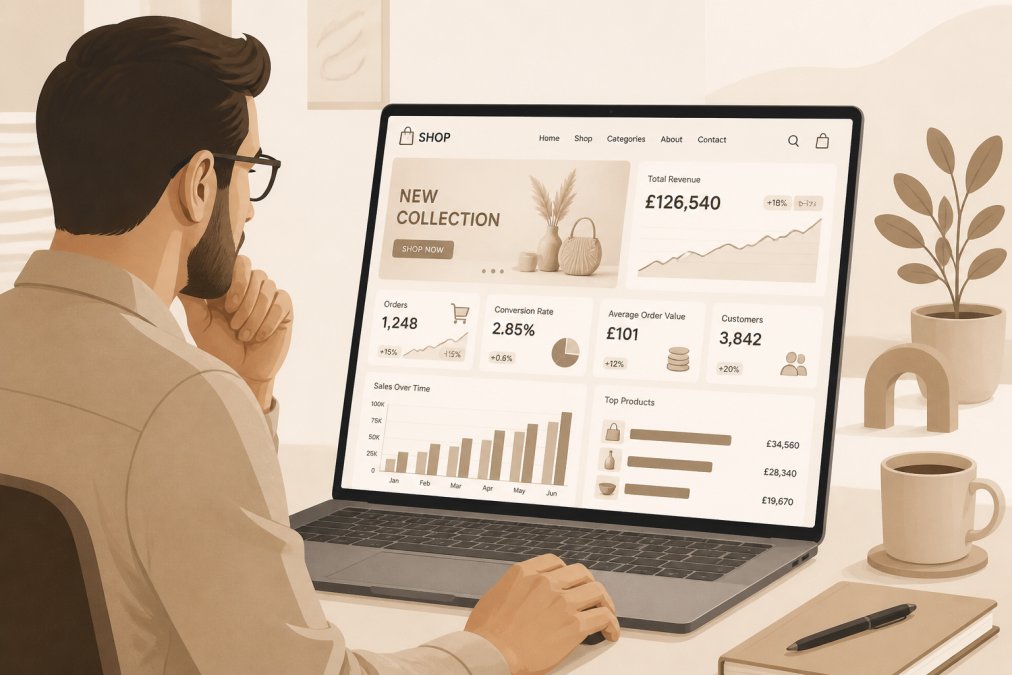
Custom ecommerce design means building your platform from the ground up, typically using open-source frameworks. You own the architecture and can build exactly what your business requires, integrate with any system, and modify behaviour without platform constraints. Our Web Design service specialises in creating bespoke ecommerce solutions tailored to your exact business needs.
The trade-off: significantly higher initial development cost, longer time-to-market, and ongoing maintenance responsibility. You manage hosting, security updates, and feature development.
Scalability and long-term growth potential reveal why this distinction matters. Template platforms scale horizontally through their infrastructure but don’t scale to your specific business needs. Custom platforms evolve with your business. A custom platform built for a business can serve a larger business. A template platform might force you to migrate entirely.
Time-to-market and deployment speed strongly favour templates. A Shopify store launches in days; a custom platform takes weeks or months. For businesses needing to test a market quickly, templates win. For businesses with complex requirements, custom development is the only path that doesn’t compromise functionality.
Benefits of Bespoke Ecommerce Website Design
Custom ecommerce design delivers advantages that compound over time, which is why return on investment analysis must span multiple years.
Brand identity and competitive differentiation represent the most underrated benefit of custom design. Your website is your storefront. Template platforms are recognisable; customers see the same design patterns across competitors. A bespoke ecommerce website reflects your brand precisely. Your checkout process, product presentation, and user experience are distinctly yours.
Research shows that distinctive, well-designed experiences increase customer trust and reduce abandonment. Custom design also allows you to implement brand-specific features that competitors can’t easily replicate, personalised product recommendations based on your business logic, checkout flows optimised for your customer segments, and custom bundling that reflects your product strategy.
Conversion rate optimisation and user experience improvements often justify custom design investment alone. Your template platform is designed for average users. Custom platforms allow you to optimise every step of the customer journey for your actual audience.
Common conversion improvements from custom design include reducing checkout steps, implementing progressive profiling, custom product filtering that matches how your customers search, personalised pricing based on customer segment, and simplified returns workflows. These optimisations compound. A 15% improvement in conversion rate on a business can generate significant additional monthly revenue. Over three years, that’s substantial additional revenue.
The highest-impact conversion improvements are almost always specific to your business model. Template platforms can’t optimise for your specific customers because they’re optimising for everyone. Custom platforms optimise for your actual business, which is why they typically outperform templates on conversion metrics.
ROI of Custom Ecommerce Design: Total Cost of Ownership Over 3-5 Years
Evaluating whether custom ecommerce design is worth the cost requires looking beyond initial development spend. Total cost of ownership over three to five years tells the real story.
Initial development costs for a custom ecommerce platform vary depending on complexity. A straightforward shop with basic integrations sits at the lower end; a sophisticated platform with complex workflows sits at the higher end. This is a significant upfront investment.
Ongoing operational costs include hosting, security maintenance, software updates, and developer time for new features. Template platforms include support in monthly fees. Custom platforms require you to budget for technical support separately.
A business generating revenue through a template platform might achieve a 2.5% conversion rate. The same business on a well-optimised custom platform might achieve 2.9% conversion, a realistic improvement from optimisation. That’s additional monthly revenue that justifies the custom platform investment.
Hidden costs and technical debt in custom builds represent the biggest risk. Poor architecture decisions compound over time. A platform built without proper API design becomes increasingly difficult to integrate with new systems. A platform built without scalable database architecture slows down as you add products and customers.
The difference between a lower-cost custom build and a higher-cost custom build often isn’t features; it’s architecture quality. The cheaper build might work initially. By year three, you’re paying for constant maintenance. The more expensive build was designed for growth and requires minimal maintenance.
Maintenance, security compliance, and ongoing support requirements are often underestimated. Your custom platform is your responsibility. Security patches, software updates, database optimisations, and backup management all fall to you. A template platform handles this automatically.
A business running a custom ecommerce platform should budget for regular technical support and maintenance. A template platform includes support in the monthly fee, offering convenience and risk reduction. For small businesses without internal technical teams, this convenience often justifies the template approach.
When Custom Ecommerce Design Makes Business Sense
Custom ecommerce design makes sense in specific situations. Recognising whether your business fits these criteria prevents expensive mistakes.
Decision matrix for business size and maturity reveals when custom design becomes worthwhile. A business with lower annual revenue doesn’t need custom ecommerce design. A template platform serves that scale perfectly. The overhead of maintaining a custom platform would exceed any benefit.
A business with moderate to significant annual revenue sits at the inflection point. Template platforms can handle the volume, but custom design might unlock meaningful revenue improvements. A business with substantial annual revenue almost always benefits from custom design. Custom optimisations that improve conversion by even a small percentage generate substantial additional annual revenue.
Custom design also makes sense when your business model is unusual. A traditional e-commerce shop selling standard products fits template platforms perfectly. A business with complex pricing logic, custom bundling, or unusual workflow requirements needs custom design. Template platform constraints become limiting rather than helpful.
Additionally, custom design makes sense when you’re building a platform-as-a-service or multi-tenant system. Template platforms aren’t designed for this use case.
Businesses with significant annual revenue, complex business models, or specific technical requirements that template platforms cannot accommodate. For smaller businesses with straightforward product catalogues, template solutions typically deliver better value.
Red flags and when templates suffice help you avoid overinvesting in custom design. If your product catalogue is straightforward, your pricing is simple, and you don’t have complex integrations, a template platform almost certainly makes sense.
Red flags that you’re overcomplicating with custom design: your business model is identical to competitors, you don’t have specific technical requirements templates can’t meet, your team lacks internal technical capability to maintain custom code, your revenue doesn’t justify ongoing support costs, or you’re building custom design to solve problems that template optimisations could address.
Template platforms have improved dramatically. Unless you’re in the 5% with genuinely unusual needs, a template solution is the rational choice. Many business owners pursue custom development for prestige rather than business necessity. A well-optimised template platform outperforms a poorly justified custom build every time.
Conclusion: Making the Right Choice for Your Business
Is custom ecommerce design worth the cost? Only if it solves a specific business problem that template platforms cannot address, and only if the revenue impact justifies the investment.
For most small businesses in Norfolk and Suffolk, template solutions deliver better value. They launch faster, cost less, and require no technical maintenance.
For businesses with complex requirements, significant revenue, or unusual business models, custom design becomes worthwhile. The investment unlocks capabilities and optimisations that drive measurable revenue improvement.
The decision comes down to this: what business problem are you trying to solve? If it’s "I need an online shop," a template platform solves it. If it’s "I need a platform that handles my specific workflow, integrates with my systems, and optimises for my customers," custom design becomes necessary.
At Ibertech Solutions, we help businesses in Norfolk and Suffolk make this decision clearly. Our team assesses your specific requirements, calculates realistic return on investment, and recommends the approach that serves your business best. We provide bespoke Web Design with ongoing technical support, ensuring your platform evolves with your business rather than constraining it.
Call us today to discuss whether custom ecommerce design makes sense for your business.
Frequently Asked Questions
How much does custom ecommerce design cost in the UK?
Custom ecommerce design costs vary significantly based on complexity, features, and integration requirements. Factors include bespoke functionality, payment gateway integration, inventory management systems, and third-party API connectivity. For an accurate quote tailored to your specific business requirements, contact a local development partner who can assess your exact needs and provide transparent pricing based on your project scope.
What are the main benefits of bespoke ecommerce website design?
Bespoke ecommerce websites offer superior brand identity, custom user experience optimisation, and scalability for growth. Unlike templates, custom builds provide proprietary functionality aligned to your business model, better SEO-friendly architecture, and the ability to integrate seamlessly with your existing systems. You gain competitive differentiation, improved conversion rates, and a platform built for your long-term vision rather than generic constraints.
When should a UK business choose custom ecommerce design over templates?
Choose custom design if you have complex business requirements, need specific third-party integrations, require mobile-first responsive design tailored to your audience, or plan significant growth. Templates suit startups testing markets quickly, but custom solutions pay dividends for established businesses with unique workflows, high transaction volumes, or specialist product categories. Consider your total cost of ownership over 3-5 years, not just initial investment.
What hidden costs should I expect with a custom ecommerce build?
Beyond initial development, budget for ongoing maintenance, security compliance updates, hosting infrastructure, technical debt management, and staff training. Platform migration costs, vendor lock-in risks, and the need for continuous optimisation add to total cost of ownership. Ensure your development partner provides transparent support agreements and clearly defines what's included in ongoing maintenance so unexpected costs don't derail your ROI.