
Table of Contents
- What Are Managed IT Services for Manufacturing Firms?
- Why Specialised IT Support Is Critical for Manufacturing Operations
- Key Services Included in Managed IT for Manufacturing
- Cybersecurity for Manufacturing: Protecting IT and OT Environments
- IT and OT Convergence in Manufacturing: Bridging the Gap
- Cloud Solutions and Manufacturing ERP Support
- Data Backup, Disaster Recovery, and Business Continuity
- How to Choose a Managed IT Service Provider for Your Manufacturing Firm
Managed IT Services for Manufacturing Firms: 2026 Guide
Last Updated: July 20, 2026
Manufacturing firms face unprecedented pressure to keep operations running smoothly whilst protecting critical systems from cyber threats. Managed IT services have become essential infrastructure. At Ibertech Solutions, we’ve observed that manufacturers implementing proactive IT management reduce unplanned downtime by an average of 40% compared to reactive support models.
What Are Managed IT Services for Manufacturing Firms?
Managed IT services represent a fundamentally different approach than traditional break-fix models. Instead of calling IT only when systems fail, you get continuous monitoring, preventive maintenance, and 24/7 technical support from experts who understand your industry.
These services encompass network management, cybersecurity, cloud infrastructure, data backup, disaster recovery, and help desk support. The key distinction is proactive intervention, your MSP identifies potential issues before they disrupt production lines, contrasting sharply with reactive support where you lose money during every minute of downtime.
Manufacturing environments are uniquely complex, managing both IT systems (servers, workstations, databases) and OT (Operational Technology) systems (PLCs, SCADA systems, industrial controllers). Specialised managed IT services bridge this gap, ensuring your production equipment stays connected and secure without compromising operational integrity.
The real value of managed IT services isn’t the help desk, it’s the prevention. A single production line shutdown can cost thousands per hour. Proactive monitoring that stops that shutdown pays for itself instantly.
Why Specialised IT Support Is Critical for Manufacturing Operations
Manufacturing operations differ fundamentally from office environments. Your production floor can’t tolerate the same update schedules as a marketing department. A security patch requiring a reboot might need to happen during a scheduled maintenance window, not immediately.
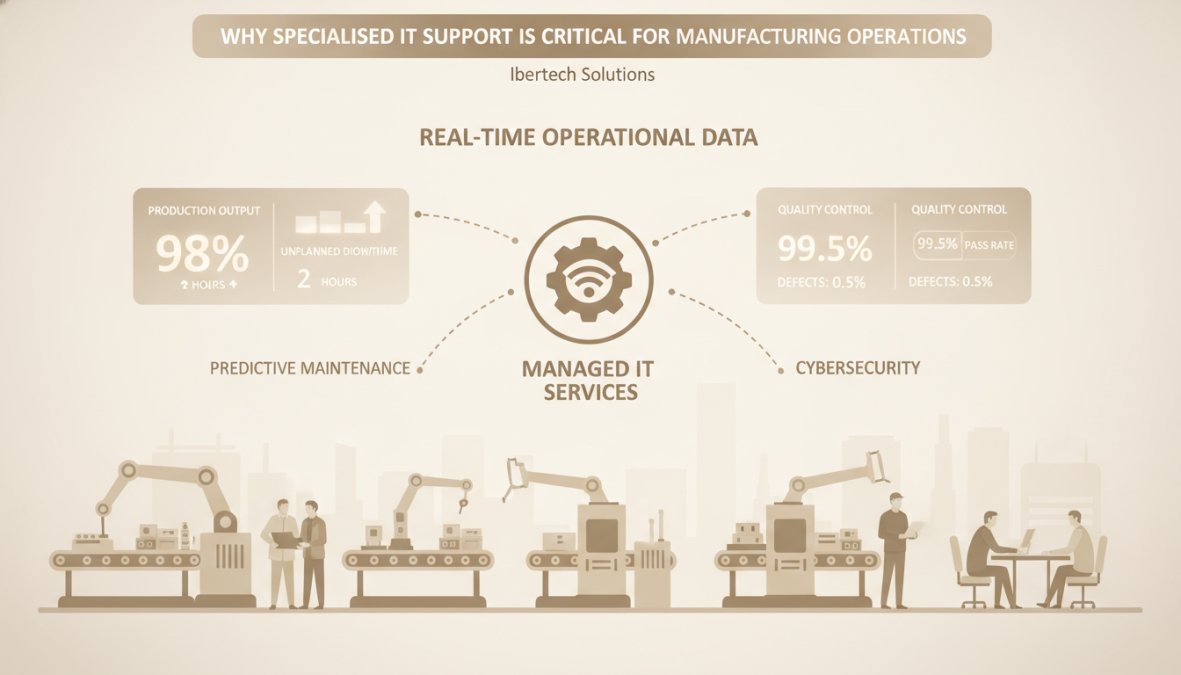
Specialised IT support recognises these constraints. Your MSP understands production scheduling, inventory management, supply chain dependencies, and regulatory compliance specific to manufacturing. They know that downtime cascades, when one system fails, it affects scheduling, quality control, shipping, and customer delivery commitments.
Companies that view IT strategically, integrating it with operational planning, see measurable improvements in efficiency, quality, and profitability. This requires partners who speak both languages: technology and manufacturing.
Compliance adds another layer of complexity. Manufacturing firms often handle sensitive intellectual property or regulated materials requiring strict security controls. NIST, ISO 27001, and CMMC compliance aren’t optional if you work with government contracts. Generalised IT support rarely meets these standards.
Downtime in manufacturing is catastrophic. A 4-hour production halt in a mid-sized facility can mean 20,000 units delayed, customer penalties, and supply chain disruption. Proactive monitoring prevents this.
Key Services Included in Managed IT for Manufacturing
Effective managed IT services bundle several core components essential for manufacturing operations.
24/7 Monitoring and Help Desk Support
Round-the-clock monitoring means your systems are watched continuously, even during night shifts and weekends. When a server temperature rises, memory usage spikes, or a backup fails, your MSP detects it immediately and takes corrective action before it affects production.
Manufacturing-focused help desks understand ERP systems, MES (Manufacturing Execution Systems), and production software. Response time matters enormously, critical production issues should have 15-30 minute response times. Ensure your contract specifies SLAs clearly and matches your operational reality.
Network Management and Infrastructure
Your manufacturing network carries both office traffic and production data, requiring different handling. Office networks prioritise user experience; production networks prioritise reliability and deterministic latency.
Specialised network management includes network segmentation separating IT and OT traffic, redundancy ensuring critical connections have backup paths, Quality of Service prioritising production traffic, and load balancing distributing traffic efficiently. Infrastructure management covers servers, storage, and virtualisation, with upgrade planning and capacity forecasting that minimise disruption.
Network segmentation is non-negotiable in manufacturing. Your production systems must be isolated from office networks to prevent a compromised workstation from affecting production equipment.
Cybersecurity for Manufacturing: Protecting IT and OT Environments
Cybersecurity in manufacturing requires defending two distinct domains. Information Technology (IT) includes servers, databases, and business systems. Operational Technology (OT) includes production equipment, industrial controllers, and sensors. They require different security approaches.
IT security focuses on traditional threats: ransomware, data theft, phishing attacks. OT security focuses on availability and safety. A ransomware attack on your ERP database is serious; malware causing a production machine to malfunction unsafely is catastrophic.
As manufacturing becomes more connected through IoT sensors, cloud analytics, and remote monitoring, the line between IT and OT blurs. Your security strategy must account for this integration.
Effective manufacturing cybersecurity includes endpoint protection, firewall management, intrusion detection, regular penetration testing, and employee security training. Manufacturing firms are increasingly targeted because disrupting production has immediate financial impact.
Ransomware is the top threat. Attackers know manufacturers will often pay to restore production quickly. Your MSP should include ransomware detection, backup immutability (backups that can’t be encrypted), and incident response planning.
Data protection is equally critical. Your intellectual property, designs, processes, and formulations have enormous value. Encryption of sensitive data, access controls, and audit logging ensure that even if attackers breach your network, they can’t read your most valuable information.
IT and OT Convergence in Manufacturing: Bridging the Gap
The distinction between IT and OT is dissolving. Modern manufacturing uses IoT sensors, cloud analytics, real-time dashboards, and predictive maintenance algorithms requiring seamless integration between production equipment and business systems.
This convergence creates opportunity and risk. You can monitor production in real-time, predict equipment failures before they happen, and optimise resource allocation. However, connecting production equipment to networks exposes it to cyber threats it was never designed to withstand.
Bridging this gap requires network segmentation isolating OT systems whilst allowing necessary data flow, industrial firewalls understanding production protocols, OT-specific monitoring detecting anomalies in equipment behaviour, change management ensuring updates don’t introduce vulnerabilities, and staff training on cybersecurity implications.
The best managed IT providers for manufacturing have dedicated OT security expertise, understanding industrial protocols, equipment lifecycles, and production constraints. Generic IT security expertise is insufficient.
OT security prioritises safety and availability over everything else in production environments. It’s about preventing equipment malfunction, not just data theft.
Cloud Solutions and Manufacturing ERP Support
Cloud computing offers significant advantages for manufacturing: scalability, automatic updates, reduced capital expenditure, and accessibility from anywhere. Cloud-based ERP systems like SAP, Oracle, and NetSuite eliminate on-premises server maintenance and simplify disaster recovery.
Scalability is genuine, during peak production seasons, you expand computing capacity instantly; during slower periods, you scale down and pay less. Cloud also simplifies compliance, as major cloud providers maintain certifications for NIST and ISO 27001.
However, cloud migration requires careful planning. Your ERP system contains critical business data, and migration must be executed carefully to avoid data loss. Your MSP should have experience migrating manufacturing systems with detailed planning, testing, and rollback procedures.
Data residency matters. Some regulations require data to stay in specific geographic regions. Your cloud strategy must account for these constraints.
Data Backup, Disaster Recovery, and Business Continuity
Manufacturing firms cannot afford data loss. Your ERP database contains years of production history, customer orders, inventory records, and financial data. Loss means you can’t fulfil orders or prove what you’ve produced.
Effective backup strategy includes multiple backup copies stored in different locations, immutable backups that can’t be deleted or encrypted by ransomware, regular restore testing, documented recovery procedures, and clear ownership for backup success.
Disaster recovery goes beyond backup, it’s the ability to restore entire systems and operations. A true plan includes detailed procedures for critical systems, identified personnel responsible for each step, estimated recovery times, acceptable data loss parameters, and regular testing (at least annually).
Business continuity planning addresses broader questions: if your main facility becomes unusable, can you continue operating? This might mean alternative production locations, temporary office space, communication protocols, financial reserves, and insurance coverage.
| Component | Purpose | Frequency |
|---|---|---|
| Full backup | Complete data snapshot | Weekly or daily |
| Incremental backup | Changes since last backup | Daily |
| Immutable backup | Cannot be deleted or encrypted | Weekly |
| Backup restoration test | Verify backups work | Quarterly |
| Disaster recovery drill | Test full recovery procedures | Annually |
How to Choose a Managed IT Service Provider for Your Manufacturing Firm
Selecting the right MSP is one of the most important technology decisions you’ll make. Evaluate potential providers on these criteria:
Manufacturing experience. Does the provider have experience with manufacturing firms similar to yours? Have they managed ERP systems and OT environments? Ask for manufacturing references.
Specialised expertise. Do they have dedicated staff for cybersecurity, cloud migration, and OT security, or are they a generalist shop?
Proactive monitoring. Can they explain their monitoring approach? What systems do they monitor? How do they prioritise issues?
Security certifications. Are staff certified in security (CISSP, CEH)? Do they maintain SOC 2 Type II certification?
Response times. What are their SLA guarantees for critical vs. non-critical issues? Manufacturing requires faster response times.
Scalability. Can they grow with you? What’s their process for onboarding new equipment?
Transparency. Do they provide clear reporting on what they’re monitoring, issues found, and fixes applied?
Local presence. For some issues, remote support isn’t sufficient. Does the provider have local staff who can visit on-site?
Vendor Lock-in and Exit Strategies
Address vendor lock-in directly in contract negotiations. Ensure you can export all data in standard formats and require comprehensive documentation of systems and configurations. Include contractual language requiring the MSP to cooperate with transition to a new provider, including staff training and parallel operation support.
Consider shorter initial contract terms (1-2 years) with renewal options, giving you exit points if the relationship isn’t working. For critical systems, consider requiring source code or configuration escrow.
The best protection against lock-in is selecting the right provider initially. A good MSP doesn’t need lock-in because you’ll want to stay.
Manufacturing firms that embrace managed IT services gain significant competitive advantages: reduced downtime, stronger security, better compliance, and lower long-term costs. The right provider becomes a true partner, helping you optimise operations and respond to market changes faster than competitors relying on reactive support.
At Ibertech Solutions, we understand manufacturing’s unique technology challenges. Our team provides 24/7 monitoring, proactive maintenance, and specialised support for production environments. We help manufacturing firms in Norfolk and surrounding areas keep systems running smoothly whilst protecting intellectual property and ensuring regulatory compliance. Call us today to discuss how managed IT services can transform your operations.
Frequently Asked Questions
What exactly are managed IT services for manufacturing firms, and how do they differ from standard IT support?
Managed IT services for manufacturing firms provide proactive, 24/7 monitoring and support tailored to the unique demands of production environments. Unlike reactive IT support that responds to problems after they occur, managed services use continuous monitoring, predictive maintenance, and strategic planning to prevent downtime before it impacts your production lines. This includes network management, cybersecurity, data backup, compliance support, and integration with systems like ERP and MES platforms that are critical to manufacturing operations.
How do managed IT services help reduce production downtime and improve operational efficiency?
Managed IT services employ proactive monitoring to identify and resolve issues before they cause production halts. By maintaining system health, applying patches promptly, and ensuring robust backup and disaster recovery protocols, manufacturers experience fewer unplanned outages. Additionally, these services help optimise cloud infrastructure, streamline ERP systems, and provide strategic technology planning that aligns IT investments with production goals, ultimately improving overall operational efficiency and reducing costly downtime.
What should I look for when choosing a managed IT service provider for my manufacturing business?
Look for providers with proven experience in manufacturing, particularly those who understand both IT and operational technology (OT) environments. Verify they offer 24/7 support, have expertise in compliance standards relevant to your industry (such as NIST or ISO 27001), and can demonstrate measurable results through case studies or references. Ensure they provide transparent service level agreements (SLAs), explain their approach to avoiding vendor lock-in, and offer flexible support options, both remote and on-site, tailored to your firm's size and complexity.
How does cybersecurity for manufacturing differ from general IT cybersecurity, and why is it important?
Manufacturing cybersecurity must protect both IT systems (business data, networks) and OT systems (production equipment, industrial controls). OT environments require different security approaches because downtime can halt production and threaten safety. A specialised managed IT provider understands these distinctions and implements layered defences including endpoint protection, firewall management, ransomware prevention, and compliance with standards like CMMC for defence contractors. This integrated approach protects your intellectual property, production data, and operational continuity.
What is IT and OT convergence, and why should manufacturing firms care about it?
IT/OT convergence refers to the integration of traditional information technology (IT) systems with operational technology (OT) systems that control production equipment. As manufacturers adopt Industry 4.0 technologies like IoT sensors, data analytics, and automation, these once-separate systems increasingly need to communicate securely. Managed IT providers experienced in IT/OT convergence help manufacturers bridge this gap safely, ensuring that data flows between production floors and business systems without compromising security or operational stability, whilst enabling real-time visibility and predictive maintenance.