Table of Contents
- Why Small Businesses Need Managed IT Services: An Overview
- Predictable Costs and Budget Control: Managed IT Support Cost UK
- Proactive Monitoring vs. Reactive Break-Fix: The Break-Even Analysis
- Cybersecurity and Threat Protection for Small Business UK
- System Uptime and Business Continuity
- Managed IT Services Benefits for Small Business UK
- IT Outsourcing for Small Business UK: Vendor Selection and Integration
- Compliance, Data Protection, and Risk Management
Last Updated: July 24, 2026
Why Small Businesses Need Managed IT Services: An Overview
Small businesses face an urgent reality: IT problems hit harder when you lack dedicated technical staff. A 2026 Gartner report on SMB infrastructure found that unplanned downtime costs small businesses an average of £5,600 per hour in lost productivity. Yet many small firms still treat IT as a cost to minimise rather than an investment to protect their operations.
This guide explores why small businesses need managed IT support, covering cost predictability, cybersecurity, uptime, expertise, scalability, and the hidden risks of trying to go it alone.
Predictable Costs and Budget Control: Managed IT Support Cost UK
Moving from unpredictable break-fix spending to a fixed monthly fee is one of the clearest reasons why small businesses need managed IT services. Instead of facing surprise invoices when systems fail, you pay a predictable monthly amount that covers monitoring, maintenance, and support.
Most small businesses operate on Operating Expenses (OpEx) rather than Capital Expenses (CapEx). Managed IT aligns perfectly with this model: your IT costs appear as a straightforward monthly line item, making budgeting infinitely easier. You know exactly what you’re spending on technology support, with no emergency calls to finance when a server fails.
A break-fix model charges only when something breaks, which sounds economical until you realise that reactive repairs cost significantly more than proactive maintenance. A hard drive failure that could have been caught through monitoring costs £300 to replace reactively, versus £50 of preventive monitoring that catches warning signs weeks in advance. Small firms typically find that managed IT services cost between 8-12% of their annual IT budget, compared to 15-20% for reactive break-fix approaches.
Fixed monthly costs let you forecast IT spending accurately. Reactive break-fix creates budget surprises that damage cash flow when you can least afford them.
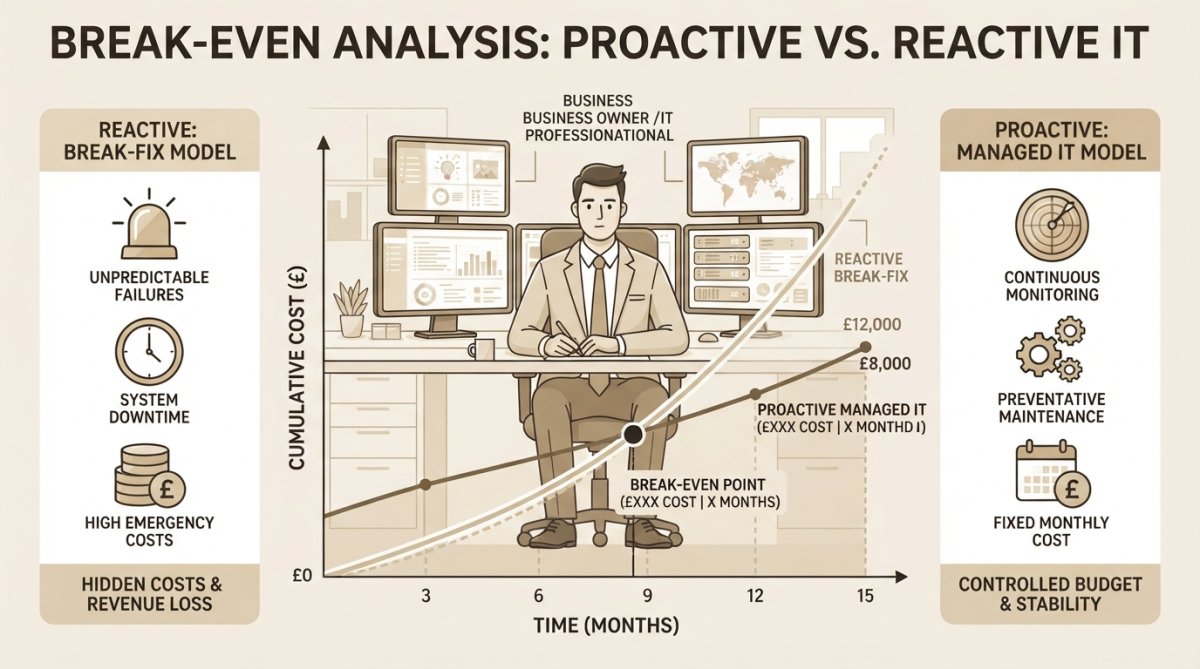
Proactive Monitoring vs. Reactive Break-Fix: The Break-Even Analysis
Most small businesses wait for problems to happen, then pay premium prices to fix them. This break-fix model is expensive by design.
Proactive monitoring changes this equation entirely. An MSP watches your systems 24/7 using Remote Monitoring and Management (RMM) tools that track performance, security threats, and hardware health. When a warning appears, a failing hard drive, unusual network traffic, or a security vulnerability, your MSP acts before the problem cascades into downtime.
The break-even analysis is straightforward. Suppose your business loses £2,000 in revenue per hour of downtime. A single unexpected server failure costs £10,000-£15,000 in lost sales plus emergency repair fees. Proactive monitoring prevents that failure entirely, catching warning signs weeks in advance. The monthly cost of monitoring typically pays for itself the moment it prevents one serious outage.
Consider a manufacturing firm with 15 staff. Their old break-fix provider charged £150 per hour for emergency repairs, with two major incidents per year costing £3,000 each. After switching to managed IT with proactive monitoring, they’ve had zero unplanned outages in two years. The monthly monitoring fee has saved them £6,000 in emergency repairs alone, not counting lost revenue prevented.
Break-fix providers profit when your systems fail. They have no incentive to prevent problems. Managed IT providers profit when your systems stay healthy, creating aligned incentives that protect your business.
Cybersecurity and Threat Protection for Small Business UK
Small businesses are increasingly targeted by cybercriminals who know that small firms typically lack the security posture of larger enterprises. A 2026 UK Cyber Security Breaches Survey found that 32% of UK businesses experienced a breach or attack in the past year, with small businesses disproportionately affected because they lack dedicated security staff.
An MSP provides layered security that most small firms couldn’t afford to build alone: endpoint security on every device, phishing protection at the email gateway, network monitoring for unusual traffic patterns, and regular security updates that patch vulnerabilities before they’re exploited.
Without this protection, a single employee clicking a malicious email link installs ransomware that encrypts your files and demands payment. With proper managed IT security, that attack is stopped before reaching your systems. Phishing protection catches the malicious email. Endpoint security blocks the malware. Network monitoring alerts your MSP to unusual activity. The threat never reaches your data.
Enable multi-factor authentication (MFA) on all accounts immediately. This single control blocks 99.9% of account takeovers, even when passwords are compromised. Most MSPs enforce this as part of standard security baseline.
System Uptime and Business Continuity
Downtime is the silent killer of small business profitability. Every hour your systems are offline, you’re losing revenue, disappointing customers, and damaging reputation.
An MSP manages your IT infrastructure with uptime as the primary objective. They implement redundancy, backup internet connections, redundant servers, automated failover systems, so that if one component fails, another takes over automatically. Your business keeps running whilst the failed component is repaired.
Most managed IT providers guarantee 99.5% uptime through a Service Level Agreement (SLA), meaning no more than 3.6 hours of downtime per month. Compare that to a small firm running on a single internet connection with no backup: a single fibre cut takes you offline for hours, possibly days.
Data backup and recovery is critical. Your MSP maintains automated daily backups of all critical systems and data. If ransomware, hardware failure, or accidental deletion strikes, you recover from the previous night’s backup, losing at most one day of work, not weeks of data.
Managed IT Services Benefits for Small Business UK
Beyond cost, security, and uptime, managed IT delivers benefits that directly impact your ability to grow and compete.
Access to Specialist Expertise Without Full-Time Headcount
Hiring a full-time IT manager costs £35,000-£50,000 per year in salary alone, plus benefits, training, and equipment. A small business with 15-20 staff can rarely justify that expense, yet you still need technical expertise.
An MSP gives you access to a team of specialists, network engineers, security experts, cloud architects, without the fixed cost of full-time staff. You get expertise on-demand, scaled to your actual needs. When you need to migrate to cloud infrastructure, a specialist handles it. When you need to set up a new office, your MSP designs the network. When you need compliance support, a security expert guides you through the requirements.
Scalability for Growth
Your IT infrastructure must grow with your business, but predicting that growth is difficult. With an MSP, scalability is built in. You need five new user accounts next month? Done in minutes. You’re opening a second office? Your MSP extends your network infrastructure. You don’t buy new servers; you add capacity to your managed service.
This flexibility is impossible with in-house IT. You either over-invest in infrastructure or under-invest and face bottlenecks when growth arrives faster than expected.
Focus on Core Business Objectives
Every hour your team spends troubleshooting IT problems is an hour they’re not spending on what they do best. An MSP removes IT from your daily concerns. Your team doesn’t spend Friday afternoon waiting for the internet to come back up. Your finance manager doesn’t spend time resetting forgotten passwords. Your operations manager doesn’t worry about whether backups are running.
Small businesses that outsource IT to a reliable MSP report improved productivity, faster project delivery, and better employee satisfaction.
Managed IT frees your team to do what they were hired to do. The cost of an MSP is almost always less than the cost of your team’s lost productivity when dealing with IT problems.
IT Outsourcing for Small Business UK: Vendor Selection and Integration
Not all MSPs are equal. Choosing the right partner is critical.
Vetting Your MSP: Key Selection Criteria
Start with experience in your industry. A managed IT provider experienced with manufacturing has different expertise than one focused on healthcare or retail. They understand your specific compliance requirements and the business impact of your systems failing.
Check their Service Level Agreement carefully. What uptime do they guarantee? What’s their response time for critical issues? Do they offer 24/7 support or only business hours?
Ask about their monitoring and management tools. Do they use industry-standard RMM platforms? Can you see real-time dashboards of your system health?
References matter. Ask for three customer references in your industry and actually call them. Ask whether the MSP responds quickly to issues, whether they’re proactive in preventing problems, and whether they understand your business.
Pricing transparency is essential. Understand what’s included in their standard service and what costs extra. Hidden costs create unpleasant surprises later.
Remote and Hybrid Work Support
Modern work is distributed. Your team might be in the office, working from home, or split between multiple locations. An MSP with experience in remote and hybrid work provides secure remote access, device management, collaboration tools support, and data protection, ensuring sensitive data isn’t copied to personal devices or unsecured cloud storage.
Shadow IT and Security Risks
Shadow IT occurs when employees use unauthorised tools and services, personal cloud storage, free collaboration apps, unapproved software, to get work done. Each decision seems minor, but collectively they create massive security and compliance risks. Your data ends up in systems you don’t control, with security you can’t verify.
An MSP prevents shadow IT by making official tools easy to use and monitoring for unauthorised cloud services, addressing it through policy and better tools rather than punishment.
Shadow IT is invisible until it causes a problem. Proactive monitoring catches it early, before damage occurs.
Compliance, Data Protection, and Risk Management
Depending on your industry, you might face regulatory requirements around data protection, security, and audit trails. GDPR applies to any UK business handling personal data. Industry-specific regulations apply to healthcare, finance, and other sectors.
Compliance isn’t optional; it’s a legal requirement. The ICO (Information Commissioner’s Office) has fined small businesses tens of thousands of pounds for GDPR violations.
An MSP helps you meet compliance requirements by implementing required security controls, maintaining audit trails, ensuring proper backup and disaster recovery, and staying current as regulations change. They conduct IT risk assessments, identifying vulnerabilities before they’re exploited, and help you understand technical debt, outdated systems that are expensive to maintain and vulnerable to attack.
The question of why small businesses need managed IT has become simpler to answer: because the cost of not doing so is too high. Downtime, security breaches, lost data, and the distraction of constant IT problems all damage your bottom line far more than a managed IT partnership costs. Ibertech Solutions provides comprehensive IT support with 24/7 monitoring, proactive threat protection, and expert guidance tailored to your business size and industry. Whether you’re across Norfolk or anywhere in Suffolk, moving to managed IT transforms your IT from a source of stress into a competitive advantage. Get in touch with Ibertech Solutions today to discuss how managed IT services can protect and scale your business.
Frequently Asked Questions
What are the main benefits of managed IT services for small businesses?
Managed IT services provide small businesses with predictable monthly costs, proactive monitoring to prevent downtime, enhanced cybersecurity protection, and access to specialist expertise without hiring full-time staff. These services help reduce technical debt, improve system reliability, and free up internal resources to focus on core business objectives. A Managed Service Provider (MSP) handles routine maintenance, updates, and security monitoring, allowing your team to concentrate on growth.
How much do managed IT services cost for small businesses in the UK?
Managed IT support cost in the UK varies based on your business size, the complexity of your IT infrastructure, the level of support required, and the specific services included. Rather than expensive capital expenditure on equipment and hiring, managed IT typically operates as a predictable monthly operating expense (OpEx). For a tailored quote that reflects your actual needs, contact a local provider who can assess your current systems and recommend appropriate service levels.
How does IT outsourcing for small business UK differ from hiring in-house IT staff?
IT outsourcing through a Managed Service Provider offers flexibility, scalability, and access to a broader range of expertise than a single in-house employee. Outsourcing eliminates recruitment costs, training overhead, and the risk of key-person dependency. An MSP provides 24/7 monitoring and support, proactive system optimization, and the ability to scale services up or down as your business grows. In-house staff excel at strategic IT roadmap planning but often lack bandwidth for proactive monitoring and emerging cyber threats.
What cybersecurity protections should small businesses expect from managed IT services?
Cybersecurity for small business UK through managed IT includes endpoint security, phishing protection, regular security updates, data backup and recovery, network security monitoring, and vulnerability assessments. An MSP implements multi-layered defences to protect against cyber threats, ensures compliance with data protection regulations, and conducts regular security audits. This proactive approach significantly reduces the risk of costly breaches and downtime caused by ransomware or other attacks.