Table of Contents
- Are Managed IT Services Worth the Price? The Real Question
- What Are Managed IT Services?
- Managed IT Services Cost UK: Understanding Pricing Models
- Managed IT Services Benefits UK: What You Actually Gain
- Managed IT Services vs In-House IT UK: The Real Comparison
- Managed IT Services ROI UK: Calculating Real Return on Investment
- Hidden Costs and What to Watch For
- How to Choose the Right Managed Service Provider
Are Managed IT Services Worth the Price? A UK Guide
Last Updated: July 28, 2026
Are Managed IT Services Worth the Price? The Real Question
Downtime costs UK businesses an average of £5,600 per hour. Yet many companies still operate with reactive IT support, fixing problems only after they’ve damaged revenue, reputation, and productivity. The question isn’t whether managed IT services are worth the price, it’s whether you can afford not to have them.
At Ibertech Solutions, we’ve worked with businesses across Norfolk and Suffolk long enough to see the pattern: companies underestimate the hidden cost of in-house IT management. This guide shows you exactly what managed IT services deliver and whether the investment makes financial sense for your business.
What Are Managed IT Services?
Managed IT services are outsourced IT support where a provider monitors, maintains, and manages your entire technology infrastructure proactively. Instead of waiting for problems to happen, they prevent them before they impact your business.
This differs fundamentally from break-fix support, where you call a technician only when something breaks. A managed service provider (MSP) takes continuous responsibility for your IT environment through 24/7 monitoring, automatic security patches, backup management, user support, and future growth planning.
Most UK MSPs focus on small to medium-sized enterprises (SMEs) with 10-200 employees, offering packages ranging from basic help desk support to comprehensive cybersecurity management and disaster recovery.
Proactive Monitoring vs Break-Fix Support
Proactive monitoring catches problems before users notice them. Your MSP identifies a failing hard drive, replaces it, and your team experiences no downtime. With break-fix support, that drive fails during your busiest trading day, costing hours of lost productivity whilst waiting for a technician.
Managed IT services use remote monitoring tools that watch systems constantly, tracking CPU usage, disk space, network performance, security threats, and application health. When something approaches a problem threshold, the MSP’s team fixes it proactively. Break-fix support costs money only when something fails, and emergency repairs are expensive with premium rates for urgent callouts.
Managed IT Services Cost UK: Understanding Pricing Models
Pricing typically follows three models: per-user per-month, tiered support packages, or customised contracts based on your infrastructure and needs.
Per-User Per-Month Pricing
Most UK MSPs charge between £20-50 per user per month for comprehensive managed support. This model offers budget predictability regardless of support ticket volume. However, clarify what’s included, some providers include everything whilst others charge extra for advanced services. For smaller teams under 10 people, some MSPs set minimum monthly fees rather than strict per-user pricing.
Factors That Influence Your Actual Costs
Several factors increase pricing beyond the headline per-user cost:
Complexity of your IT environment. Legacy systems, custom applications, or complex network configurations require more expertise. A straightforward Microsoft 365 environment costs less than one mixing multiple platforms and on-premises servers.
Number of locations. Multi-site businesses pay more due to support across different locations.
Compliance requirements. Healthcare, financial services, and regulated industries require additional security controls and audit trails.
Security and backup needs. Enhanced cybersecurity and redundant backup systems increase pricing.
Support hours and response times. Standard business hours support costs less than 24/7 availability with guaranteed response times (SLAs).
| Pricing Factor | Impact on Cost |
|---|---|
| Basic managed support (20 users) | Baseline |
| Multi-location support | +15-25% |
| 24/7 availability with SLA | +30-50% |
| Advanced cybersecurity | +20-40% |
| Compliance management | +25-60% |
Managed IT Services Benefits UK: What You Actually Gain
The financial case rests on four core benefits: reduced downtime, improved security, predictable budgeting, and access to expertise you couldn’t afford in-house.
Reduced Downtime and Hidden Costs of IT Failures
Downtime is the silent cost killer. When systems fail, your team can’t work, customers can’t reach you, and revenue stops. A one-hour outage for a 20-person business might cost £2,000-5,000 in lost productivity alone.
Managed IT services prevent most outages through proactive monitoring and maintenance. Your MSP replaces failing hardware before it fails, applies security patches that prevent attacks, and maintains redundancy so if one system fails, another takes over automatically.
Calculate your actual downtime cost: multiply your team size by average hourly wage, then multiply by hours of downtime per year. Most UK businesses lose 8-20 hours annually to IT issues. For a 20-person team at £20/hour average, that’s £3,200-8,000 in lost productivity annually, often more than managed IT services cost.
Managed IT services also improve security, reduce compliance risk, and provide access to expertise. Your MSP ensures systems stay patched against vulnerabilities, implements multi-factor authentication and data encryption, and maintains backup systems protecting against ransomware.
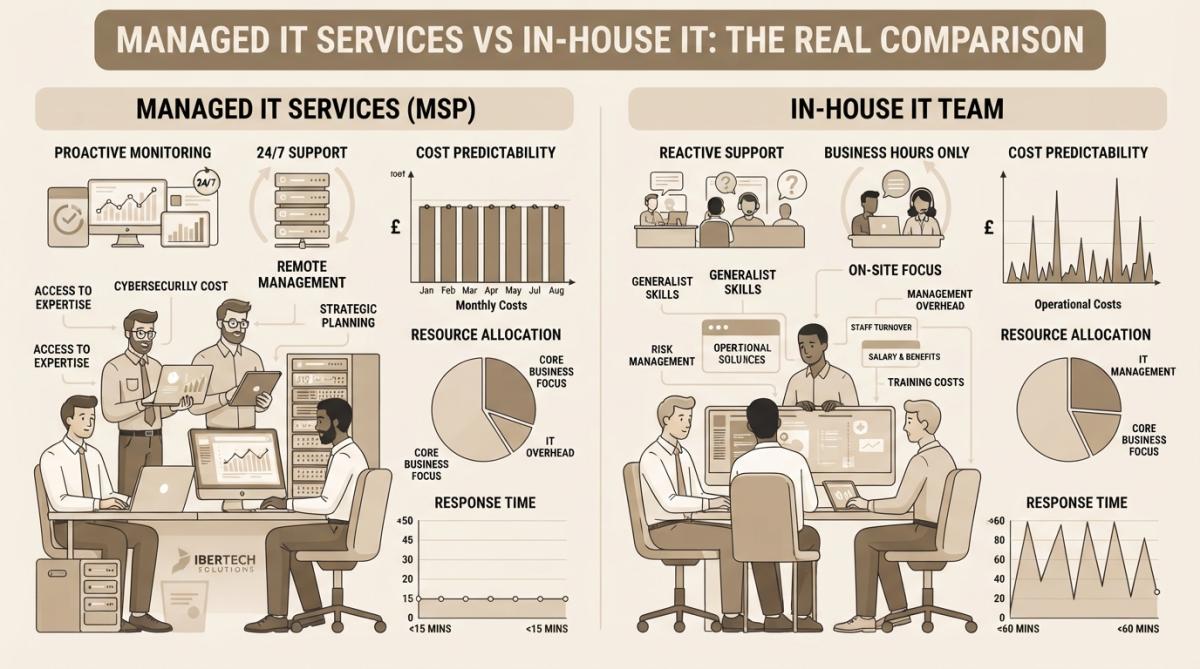
Managed IT Services vs In-House IT UK: The Real Comparison
The decision between outsourced managed IT and hiring in-house staff depends on your business size, complexity, and growth plans.
In-house IT makes sense if: You have 50+ employees, complex custom systems, or highly specialised IT needs requiring permanent staff.
Managed IT services make sense if: You have fewer than 100 employees, use standard business software, want predictable costs, or lack the budget for full-time IT staff.
For a 20-person business, managed IT services typically cost £400-800 monthly. That buys access to a team of specialists covering help desk support, infrastructure management, security, and strategic planning.
Scalability and Flexibility
Managed IT services scale automatically with your business. When you hire a new employee, your MSP adds them to the monitoring system and provides help desk support without additional infrastructure investment. When you open a second location, your MSP extends coverage there.
In-house IT teams don’t scale smoothly. Adding staff requires recruiting and training. Managed services provide flexibility, add cybersecurity support temporarily or get specialised expertise for cloud migration without permanent hiring.
Technical Expertise and Compliance
Most UK MSPs employ specialists in cloud platforms, cybersecurity, network management, and compliance. A small business couldn’t afford this breadth of expertise in-house.
This matters for compliance. If you handle customer data, you’re subject to GDPR requirements. Your MSP understands these requirements, implements controls, and maintains documentation.
Managed IT Services ROI UK: Calculating Real Return on Investment
Return on investment isn’t measured in percentage gains like marketing campaigns. It’s measured in avoided costs and operational improvements.
Total Cost of Ownership Framework
Total Cost of Ownership (TCO) compares the true cost of managing IT in-house versus outsourcing to an MSP, including salaries, infrastructure, training, recruitment, turnover, and downtime costs.
In-house IT TCO for a 20-person business:
- IT technician salary: £32,000
- Senior IT manager (part-time): £20,000
- Infrastructure (servers, networking, backup systems): £5,000-10,000 annually
- Software licences and tools: £3,000-5,000
- Training and professional development: £2,000
- Recruitment and turnover costs: £3,000-5,000
- Downtime costs (estimated): £5,000-10,000
Total: £70,000-87,000 annually
Managed IT services for the same business:
- Comprehensive managed support (20 users): £7,200
- Advanced cybersecurity add-on: £2,400
- Backup and disaster recovery: £1,200
- On-site support visits (estimated 12 per year): £2,400
Total: £13,200 annually
The managed IT option costs roughly one-sixth of in-house management whilst delivering better availability, security, and expertise.
For businesses under 50 employees, managed IT services typically cost 60-75% less than in-house IT whilst delivering better availability, security, and expertise.
Industry-Specific Value for SMEs
The value of managed IT services varies by industry. E-commerce and retail businesses relying heavily on technology see the greatest benefit through prevented downtime. Professional services firms handling sensitive client data benefit from compliance assurance and secure backup systems. Manufacturing operations prevent production stoppages through redundant systems. Healthcare and dental practices ensure NHS compliance and patient data protection. For these industries, managed IT services typically pay for themselves through avoided downtime alone within 6-12 months.
Hidden Costs and What to Watch For
Not all managed IT service contracts are equal. Several hidden costs can inflate your bill unexpectedly.
Out-of-scope charges. Your contract specifies what’s included in the monthly fee. Anything beyond that scope incurs additional charges. Always clarify what’s included before signing.
Software licensing. Some MSPs include Microsoft 365 and antivirus in their fees; others bill separately. Understand the distinction and negotiate bundled pricing.
Minimum contract terms. Many MSPs require 12 or 24-month contracts with early termination fees. Negotiate flexible terms, particularly for your first year.
Mid-contract price increases. Some contracts include automatic price increases after the first year. Push back and negotiate fixed pricing for at least two years.
Transition costs. Moving from in-house IT or another MSP involves setup, data migration, and system configuration. Some MSPs absorb this cost; others charge separately.
How to Choose the Right Managed Service Provider
Selecting an MSP is one of the most important technology decisions you’ll make. Start by defining your needs clearly: what systems must the MSP support, what’s your budget, do you need on-site support, and what compliance requirements must they meet?
Evaluate MSPs on three criteria: technical capability, service quality, and cultural fit.
Technical capability means they have expertise in your systems. If you run Microsoft 365, they should be a Microsoft partner. Service quality is measured by response times, uptime guarantees (SLAs), and customer reviews. Ask for references and contact them directly. Cultural fit matters because you’re inviting this team into your business to manage critical systems.
SLA Guarantees and Support Responsiveness
Service Level Agreements (SLAs) define what the MSP commits to. A typical SLA might guarantee 99.5% uptime for monitored systems or a 15-minute response time for critical issues.
Read the fine print carefully. Some SLAs exclude planned maintenance or third-party systems. The most important element is response time for critical issues. Also ask about escalation procedures and after-hours support availability.
Local Expertise and Vendor Stability
For businesses across Norfolk and Suffolk, local expertise matters. A local MSP understands your business community and can provide on-site support quickly. Check the MSP’s financial stability and longevity. Ask about team credentials and whether they’re certified in the technologies they support.
The question "are managed IT services worth the price" has a clear answer for most UK businesses: yes, if you choose the right provider. The investment typically costs 60-75% less than in-house IT whilst delivering better security, reliability, and expertise. For businesses under 100 employees, particularly those in technology-dependent industries or facing compliance requirements, managed IT services are a strategic investment rather than an expense.
Ibertech Solutions provides comprehensive managed IT support tailored to Norfolk and Suffolk businesses. Our local team offers 24/7 monitoring, proactive maintenance, cybersecurity management, and strategic IT planning designed specifically for growing SMEs. We ensure your systems stay secure and up-to-date, preventing downtime that costs your business revenue and reputation. Whether you’re currently managing IT in-house or frustrated with your existing provider, we can show you exactly how managed IT services will improve your operational efficiency and protect your business. Call us today to discuss your specific IT needs and receive a tailored quote.
Frequently Asked Questions
How much do managed IT services cost per user per month in the UK?
Managed IT services typically follow a per-user, per-month model, with costs varying based on service scope, business size, and provider. Pricing depends on what's included, from basic help desk support to comprehensive monitoring, cybersecurity, and cloud management. For accurate pricing, contact providers directly or request a quote tailored to your specific IT infrastructure needs and business size.
What are the main benefits of managed IT services for UK businesses?
Key benefits include proactive monitoring that prevents issues before they impact operations, reduced downtime costs, access to specialist expertise without hiring in-house staff, improved cybersecurity and regulatory compliance, scalable support as your business grows, and predictable fixed-fee pricing. Managed IT services also free your team to focus on strategic initiatives rather than firefighting technical problems.
How does managed IT services ROI compare to keeping in-house IT support?
ROI depends on your current costs. In-house IT requires salary, benefits, training, and recruitment costs, plus equipment and tools. Managed IT services offer predictable monthly costs, eliminate recruitment overhead, and provide access to broader expertise. For SMEs with fewer than 50 staff, managed services typically deliver better ROI by reducing technical debt and downtime costs that in-house teams struggle to prevent.
What hidden costs should I watch for in managed IT service contracts?
Common hidden costs include charges for additional on-site visits, software licences not included in base pricing, upgrades to cloud infrastructure, security add-ons like SOC services, and price increases for additional users or devices. Review SLA terms carefully, some providers charge extra for rapid response times. Always ask for a transparent, all-inclusive quote and clarify what happens if your business scales quickly.