

Table of Contents
- Is Outsourced IT Support Good for Retail? The Honest Answer
- Key Benefits of Outsourced IT Support for Retail Operations
- Challenges of IT Outsourcing in Retail: What You Need to Know
- Understanding the Cost of Outsourced IT Support
- Managed IT Services for Retail: What to Expect
- Choosing an IT Outsourcing Partner for Retail: Selection Criteria
- Common Mistakes Retailers Make When Outsourcing IT Support
- Conclusion: Making the Right Decision for Your Retail Business
Is Outsourced IT Support Good for Retail? A 2026 Guide
Last Updated: July 18, 2026
Is Outsourced IT Support Good for Retail? The Honest Answer
For most retailers, outsourced IT support is a smart choice. Businesses that shift to managed IT services report significantly fewer unplanned outages and faster incident resolution than those managing systems in-house. The real question isn’t whether outsourced IT support is good, it’s whether it’s right for your specific operation. A small independent retailer with 5 staff and a basic POS system faces different pressures than a multi-location chain managing complex inventory systems and e-commerce integration. This guide walks through the genuine benefits, real challenges, and practical selection criteria so you can make an informed decision.
Key Benefits of Outsourced IT Support for Retail Operations
Outsourced IT support solves specific problems that in-house teams struggle with: cost predictability, 24/7 availability, and access to expertise you couldn’t afford to hire directly.
Scalability During Peak Sales Periods and Black Friday
Retail peaks create infrastructure crises. Black Friday, Boxing Day, and seasonal sales put stress on systems that operated fine at normal traffic levels. Payment processing slows. Websites go down. Inventory systems lag. In-house IT teams are already stretched thin.
Managed IT services scale with demand. Providers maintain spare capacity for peak periods and activate additional monitoring during critical sales windows. They’ve handled this scenario hundreds of times and know where failures typically occur: database bottlenecks, network saturation, payment gateway timeouts. They implement failover systems and load balancing before the rush hits.
The cost advantage matters too. Instead of hiring a full-time infrastructure specialist earning £45,000+ annually to sit idle 90% of the year, you pay for support when you actually need it.
Start coordinating with your IT partner at least 6 weeks before peak season. They’ll run load tests on your systems, identify weak points, and implement redundancy.
24/7 Support and Business Continuity Protection
A retail system failure at 2 AM on a Saturday costs real money. Your online store can’t process orders. Your physical locations can’t ring sales. Even a 4-hour outage during peak shopping hours translates to thousands in lost revenue.
In-house IT teams can’t staff 24/7 support affordably. Managed service providers have distributed teams and on-call rotation schedules designed for exactly this scenario. When something fails at 3 AM, someone picks up the phone.
Business continuity protection goes beyond availability. Providers implement automated backups, disaster recovery plans, and failover systems. If your primary data centre experiences hardware failure, systems automatically switch to backup infrastructure without manual intervention.
Reducing Labour Costs and Hiring Overhead
Hiring in-house IT staff carries hidden costs. Beyond salary, you’re paying for benefits, training, equipment, and recruitment. Technical staff turnover is high.
Outsourcing eliminates this overhead. You pay a fixed monthly fee for support. The provider handles recruitment, training, and staff retention. When one technician leaves, they backfill with another without disrupting your service.
For small to medium retailers, this cost difference is dramatic. A single in-house IT person costs £35,000-£50,000 annually in salary plus benefits, equipment, and training. A managed service provider delivers comparable support for significantly less, with access to a team rather than one person’s knowledge.
Challenges of IT Outsourcing in Retail: What You Need to Know
Outsourced IT support isn’t a perfect solution. Real retailers face genuine problems with outsourcing.
Integration with Legacy POS Systems
Many independent retailers run POS systems installed 5-10 years ago. The vendor might be out of business. Documentation might be incomplete. The original installer might be unreachable.
A new outsourced IT provider inherits this complexity. They need to understand an old system to support it, but they didn’t build it and may not have access to source code or detailed technical specifications. When integration issues arise, connecting the POS to your e-commerce platform, syncing inventory across locations, or pulling sales data for reporting, the provider struggles.
The honest answer: legacy POS integration is expensive to fix properly. You either invest in upgrading to a modern system (significant cost) or accept that certain integrations won’t work smoothly. Some providers specialise in retail and have experience with older systems. Others will tell you it’s not their problem.
Before signing with any outsourced provider, ask specifically about their experience with YOUR POS system. Request references from other retailers using the same equipment. If they hesitate or give vague answers, move to another provider.
Data Security and Compliance Concerns
Handing your customer data, payment information, and sales records to an external company creates legitimate security anxiety. However, outsourcing doesn’t increase your security risk, it often decreases it. A professional managed service provider implements security standards that most small retailers can’t afford in-house: multi-factor authentication, encryption, intrusion detection, regular penetration testing, and compliance audits.
The actual risk is choosing the wrong provider. A reputable provider with certifications (ISO 27001, SOC 2, PCI DSS compliance) is better than managing security yourself. Ensure your provider keeps data within the UK or EU if you’re processing UK customer data.
Communication and Response Time Issues
Outsourced support introduces a communication layer. Instead of walking to the IT person’s desk, you submit a ticket. Instead of instant feedback, you wait for a callback. This friction frustrates teams accustomed to immediate help.
Response times vary wildly. Some providers guarantee response within 1 hour for critical issues. Others take 24 hours. The difference between "down for 1 hour" and "down for 24 hours" is thousands in lost sales. When evaluating providers, scrutinise their SLA (Service Level Agreement), the formal commitment to response and resolution times.
The best providers offer tiered support: critical issues get immediate response, non-critical issues get scheduled within business hours. They also provide a dedicated account manager, a single point of contact who understands your business.
Understanding the Cost of Outsourced IT Support
Pricing for outsourced IT support varies based on business size, system complexity, and the level of support you need. Factors that influence cost include the number of users and devices, system complexity, the level of proactive monitoring, and whether you need on-site visits or remote-only support.
The real cost comparison isn’t outsourced versus in-house salary, it’s total cost of ownership. Calculate what you’d spend on one full-time IT person (salary, benefits, equipment, training) plus the cost of downtime when they’re unavailable. Compare that to outsourced pricing. Most retailers find outsourcing more cost-effective, especially when factoring in the expertise you gain.
Managed IT Services for Retail: What to Expect
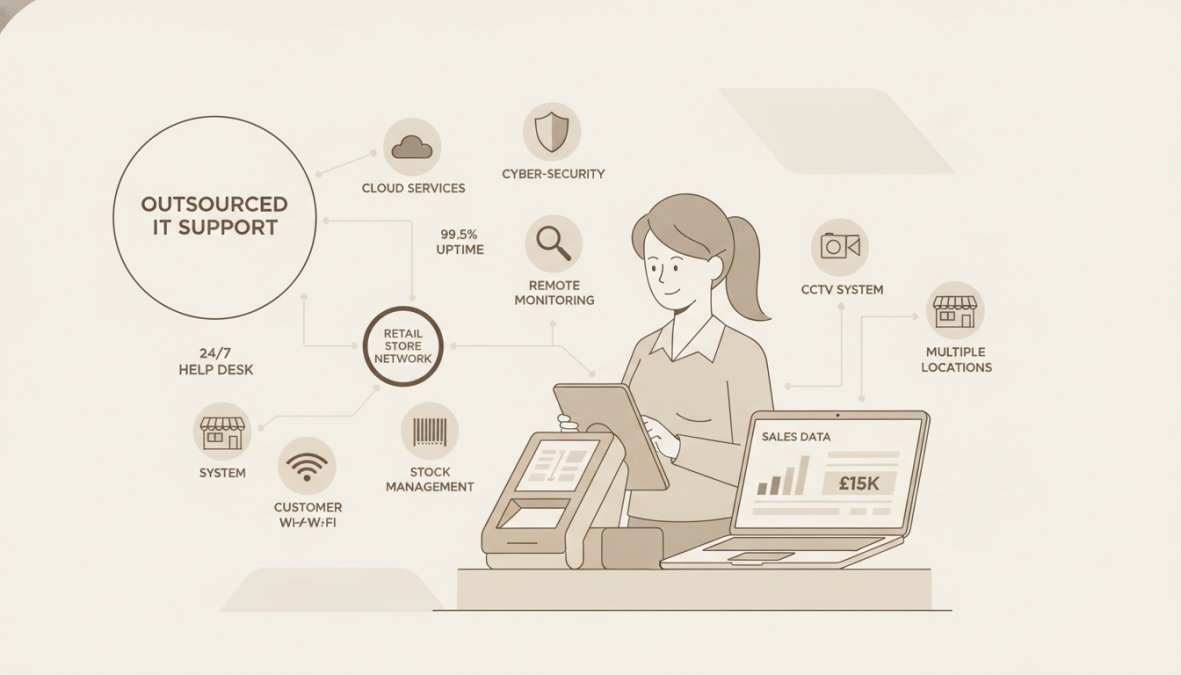
When you engage a managed IT service provider, you’re buying more than reactive support. You’re buying proactive management, monitoring, and strategic planning.
Proactive Monitoring and Downtime Prevention
The difference between good managed IT services and basic support is the shift from reactive to proactive. Basic support waits for something to break, then fixes it. Managed services monitor systems continuously, identify problems before they cause outages, and fix them during maintenance windows.
Network monitoring tools watch bandwidth usage, CPU load, storage capacity, and application performance 24/7. When a disk fills up, the provider alerts you before it crashes. When a backup fails, they know immediately and retry. When a security vulnerability is discovered, they patch systems before attackers exploit it.
Retailers benefit from this approach because downtime is expensive. An hour of POS outage during trading hours costs more than the annual cost of monitoring.
Hybrid IT Models: The Best of Both Worlds
Not every retailer needs to outsource everything. Many operate hybrid models: outsourced managed services for infrastructure and security, but keeping one internal person for day-to-day support and vendor relationships.
This approach balances cost and control. You get 24/7 expert support without paying for a full in-house team. You keep internal expertise for decisions unique to your business. The external provider handles infrastructure burden, monitoring, patching, backups, and disaster recovery.
Hybrid models work particularly well for retailers with 20-50 staff.
Choosing an IT Outsourcing Partner for Retail: Selection Criteria
Not all outsourced IT providers are equal. Choosing the wrong one creates more problems than managing IT in-house.
Vendor Selection Checklist for Retail Businesses
Before signing any contract, evaluate potential providers against these criteria:
- Retail experience: Do they have references from other retailers? Have they worked with your POS system?
- Response time guarantees: What do their SLAs actually say? Get SLAs in writing.
- 24/7 availability: Can they answer calls at 2 AM, or is 24/7 monitoring with business-hours callback?
- Local presence: Do they have technicians in your area for on-site support?
- Security certifications: Do they hold ISO 27001, SOC 2, or PCI DSS certification?
- Data residency: Where do they store your data? Ensure it meets your compliance requirements.
- Backup and disaster recovery: What’s their backup strategy? How quickly can they restore systems?
- Transparent pricing: Do they explain costs clearly? Request a detailed quote.
- Contract terms: Can you exit if unsatisfied? What happens to your data if you leave?
- Communication: Do they assign a dedicated account manager?
| Evaluation Criteria | What to Look For | Red Flags |
|---|---|---|
| Retail experience | References from similar-sized retailers, POS system familiarity | No retail clients, vague about experience |
| Response time | Written SLA with specific timeframes for critical issues | "We’ll get back to you soon" without commitment |
| Local support | Technicians in your area for on-site visits | Only remote support with no local presence |
| Security | ISO 27001, SOC 2, or PCI DSS certification | No certifications mentioned |
| Data location | UK or EU data centres with clear residency policy | Data stored in US with no control options |
| Pricing transparency | Detailed quote with itemised costs | "Contact for pricing" with no clarity |
| Contract flexibility | 12-month terms with exit clauses | 3-year lock-in with penalties |
Risk Mitigation and SLA Guarantees
An SLA (Service Level Agreement) is your protection. It defines what the provider commits to delivering and what happens if they fail. A good SLA includes:
- Response time: How quickly they’ll acknowledge a critical issue (e.g., "within 1 hour for critical issues")
- Resolution time: How quickly they’ll fix the issue (e.g., "within 4 hours for critical issues")
- Uptime guarantee: What percentage of time your systems should be available (e.g., "99.5% uptime")
- Escalation process: What happens if they miss commitments
- Service credits: What compensation you get if they fail (e.g., "1% of monthly fee credited for each hour of missed uptime")
SLAs must be specific and measurable. "We’ll provide excellent support" isn’t an SLA. "We’ll respond to critical issues within 1 hour and resolve within 4 hours, or you receive service credits" is an SLA.
Common Mistakes Retailers Make When Outsourcing IT Support
Choosing based on price alone. The cheapest provider often cuts corners on security, response time, or expertise. A provider £100 per month cheaper might cost you £10,000 in downtime losses.
Not documenting your current systems. Before outsourcing, create an inventory of everything: hardware, software, integrations, user accounts, data locations. Providers need this to understand what they’re supporting.
Ignoring the transition period. Moving to a new provider creates risk. Build in a transition period with both your old and new provider running in parallel.
Failing to establish communication protocols. How do you report issues? What’s the escalation process? Who’s your main contact? Get this in writing before problems occur.
Not reviewing performance regularly. After signing, review the provider’s performance quarterly. Are they meeting SLA targets? How many issues are they resolving proactively versus reactively?
Outsourcing without keeping internal knowledge. Keep at least one person internally who understands your business and can communicate with the provider.
The best outsourcing relationships treat the provider as an extension of your team, not a vendor you hire and ignore. Regular communication and performance review prevent small issues from becoming big problems.
Conclusion: Making the Right Decision for Your Retail Business
For most retailers, especially those without dedicated IT staff, outsourced IT support is the practical choice. The combination of cost savings, 24/7 availability, expert access, and reduced hiring burden makes outsourcing worthwhile.
But choosing the right partner matters more than the decision to outsource itself. A poor provider creates frustration and risk. A good one becomes invisible, systems stay up, security stays tight, and your team focuses on selling rather than troubleshooting technology.
Retailers looking for proven outsourced IT support should consider Ibertech Solutions. With local technicians, 24/7 availability, and specific experience supporting retail operations, Ibertech Solutions provides the combination of local expertise and enterprise-level support that independent retailers need. Their flexible virtual and on-site support options, UK-based infrastructure, and commitment to keeping systems secure and up-to-date mean you can focus on growing your business while they handle the technical complexity.
Call us today to discuss how outsourced IT support can work for your retail operation.
Frequently Asked Questions
What are the main advantages of outsourced IT support for retail businesses?
Outsourced IT support allows retail businesses to focus on core operations whilst benefiting from expert technical expertise, 24/7 monitoring, and scalable infrastructure. It reduces the burden of hiring and training internal IT staff, improves system security, and helps prevent costly downtime during critical periods like Black Friday. Managed service providers handle network monitoring, server maintenance, and cybersecurity, freeing your team to concentrate on customer service and sales.
How much does outsourced IT support typically cost for a retail business?
Pricing for outsourced IT support varies significantly based on your retail operation's size, the complexity of your IT infrastructure, the level of support required, and whether you need on-site or remote assistance. Rather than a fixed price, most providers offer flexible models tailored to your specific needs. We recommend obtaining quotes from several providers to understand what fits your budget and requirements.
What should I look for when choosing an IT outsourcing partner for retail?
Evaluate potential partners on their experience with retail-specific systems (particularly POS integration), availability of 24/7 support, security certifications, SLA guarantees, and their ability to handle peak season scalability. Ask about their approach to legacy system integration, data protection protocols, and whether they offer hybrid support models combining remote and on-site assistance. Local providers can also offer faster response times and better understanding of your business context.
Can outsourced IT support help prevent downtime during peak retail seasons?
Yes. Managed IT services include proactive network monitoring, regular maintenance, and infrastructure planning specifically designed to handle increased demand during peak sales periods. Providers implement redundancy, backup systems, and real-time monitoring to identify and resolve issues before they impact your operations. This approach is far more effective than reactive support that only responds after problems occur and customers are already affected.
What are the risks of outsourcing IT support for retail businesses?
Key risks include potential integration challenges with legacy POS systems, data security concerns if the provider lacks proper compliance measures, communication delays if support is offshore, and loss of control over your IT infrastructure. Mitigate these by choosing providers with retail experience, verifying their security certifications, establishing clear SLAs, and considering hybrid models that retain some internal oversight of critical systems.
References & Further Reading
[EXTERNAL_LINK: Gartner’s 2026 Retail Technology Trends Report | gartner.com]
[EXTERNAL_LINK: Forrester Wave: Managed Security Services Providers 2026 | forrester.com]
[EXTERNAL_LINK: National Retail Federation IT Infrastructure Best Practices Guide | nrf.com]